


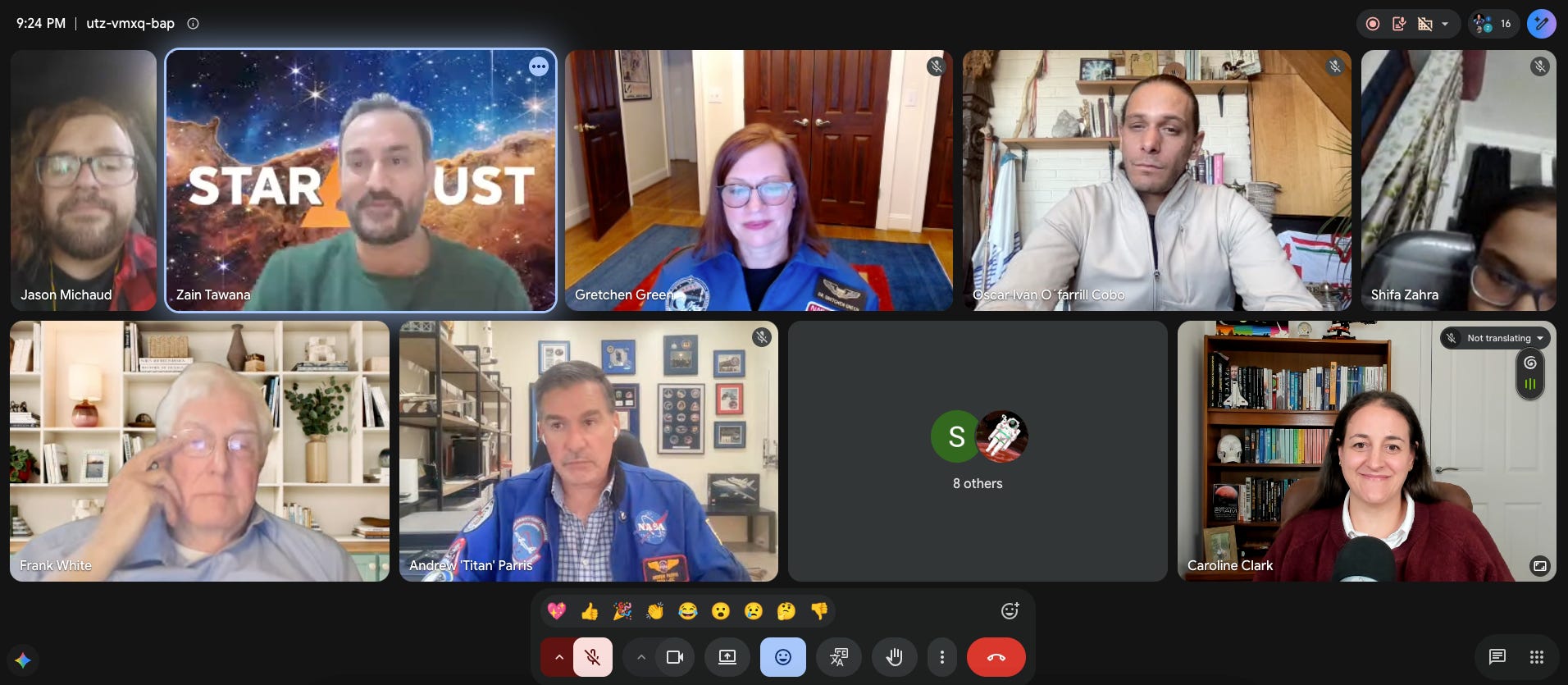
At Stardust 2026 this week I joined a panel of space experts discussing the human side of space. There was one question that stood out: what are the early signs that a crew is starting to fracture, and what do you do about it when there is no real-time support from Earth?
To answer that, you have to start with the context. What is it about the environment that creates the stress in the first place? Only then does it make sense to ask what astronauts, and the people who train them, actually do about it.
The environment as a stressor
When you think of space, there’s a lot that’s really exciting about it, but actually there’s a lot that’s really mundane as well. On an analogue mission you experience the isolation, the confinement and the resulting monotony. On the ISS, practically every minute of an astronaut’s day is scheduled out with activities, and that is tightly monitored by mission control. Even their sleep and biomarkers are tracked through wearable devices.
So you have a small group of people in a tight space, with very little privacy and very little choice over how they spend their time. And there is no way out. Here on Earth, if you have a conflict with someone, you might go for a walk to clear your head. That is not possible on the ISS, the Moon or Mars.
Then there is distance. There is a hard physical limit in the universe on how fast communication can travel, and the further you go, the more that limit bites. So you become shut off from people on Earth, and ultimately you’re on your own.
Four stresses that follow
Being on your own. When Apollo 13 had its disaster, mission control talked the crew through it and helped them work the problem, including a new way to model the scrubbers so the parts would fit together. On the way to Mars, there is no phoning home for help. In the Mars-500 analogue, the delay with mission control grew to around 40 minutes for a round-trip message, and the crew ended up becoming totally autonomous, using mission control more for advice than instruction.
Each other. Sandra Whitmire (Element Scientist, Human Factors and Behavioral Performance at NASA) pointed out that as you go from a six-person crew to a 50-person settlement, you get far more connections between people. That can help people find where they belong, but it also opens the door to negative dynamics. Ashley Lewelling (Human Factors Researcher) described how subgroups of us versus them can form, and how without a proper way to resolve conflict it just builds until it explodes. She also described a waterfall: sleep deprivation leads to tiredness, tired people make near misses, near misses create frustration and irritability, and irritability becomes conflict. Andrew Parris (NASA TV engineer) suggested we look to places that have already studied larger groups living together, like the US Navy, which has integrated its submarine crews, and the Antarctic stations.
The people left behind. Close relationships are built on intimacy, which happens in the small moments: kids fighting at the breakfast table over the toy in the cereal box, or confiding in your partner about a conflict at work. Sandra shared pilot research suggesting that at the delays anticipated for lunar missions, a few seconds each way, both the crew member and the family member feel the quality of the connection drop.
The attention cycle. When the first crew goes to Mars, the whole world will watch them blast off. Then for six to nine months they are forgotten, until the landing, when everyone is clapping again. Then the attention disappears and they are there for up to another year on their own. That cycle of enormous interest followed by what feels like complete disinterest is going to take a psychological toll, and resilience will be a big factor.
The ISS is the real analogue, and we hear little about its stress
Frank White (space researcher who coined the ‘Overview Effect’) outlined how the ISS is the real analogue for future missions, yet we hear very little about stress there. There is a tendency to talk only positively about it, and he was honest that he has mostly focused on the positive experiences himself. As he put it, that is only half the story.
Gretchen Green (flown astronaut, Blue Origin) added that it is simply impossible for life on the station to be happy all the time. It is a normal human response not to be happy when there is a life-threatening leak. She suggested starting with those incidents, then looking at the day-to-day, because the monotony and the grind need careful study too.
Frank did share one thing the ISS crews do value: the cupola. Looking at the Earth helps them feel reconnected to it.
What crews do about it
Rehearse it. The purpose of running analogues here on Earth is first to identify the stresses and how they manifest, and then to work out which psychological interventions we can put in place before, during and after a mission. Ashley made the point that you can simulate these problems in real time and learn to solve them as a team, rather than getting up there and discovering that everything has hit the fan.
Watch the signals. Sandra said one early indicator is a drop in communication, or a change in what is being communicated. There is research into lexical markers that goes beyond simply positive and negative. The idea is that a crew member could be prompted when a pattern of negativity is emerging, and equipped with useful steps for what to do about it.
Keep laughing. On my analogue mission, we laughed a lot. There were some really funny moments, like putting on all the layers to get ready for an EVA and then realising you need the toilet and have to take everything off. One of the first signs a team is struggling is when they stop laughing and stop having fun together. I saw the same inside tech companies I worked with: when people get stressed, they stop having fun. Humour requires vulnerability, because we often find funny the things we are socially repressing. Gretchen described how crew trainers at Space Camp would schedule mandatory fun, so that you can notice when it starts getting pushed out.
Name it. Every group needs a way to resolve conflict before it builds. Ashley’s suggestion was an impartial person you can bounce ideas off or turn to for support. Jason Michaud (CEO of Stardust) described a practice from one tribe, where children name what went wrong at the end of the day so it is processed rather than bottled up. Andrew added that this only works if you hear from the whole crew and really listen to what each person is trying to say, not just casually.
Protect the connection home. Families are easy to overlook. Andrew pointed out that they start to step back, because they have lives they are trying to continue, and they need as much support as the crew member if not more. His answer was to keep them involved and treat them as part of the mission. Gretchen described what that can look like in practice: she and her best friend send each other asynchronous voice messages with a loose structure of sharing some news, reflecting on what the other said, then asking for more. She suggested AI prompts or conversation cards could ease the burden of not knowing what to say. And Sandra noted that the Artemis II crew credited their families’ support for the success of their mission.
So what are the early signs that a crew is starting to fracture?
Communication that goes quiet or turns negative, subgroups forming, and the laughter fading.
What helps is rehearsing what to do in conflict before it happens, noticing it early, and staying connected to each other and to the people at home.
Safety comes from the group
Going into my own analogue mission, I had that voice in my head, the inner chimp, saying this was going to be really difficult and that I would freak out. By the second day I felt completely safe and relaxed, and I think that is testament to how we bonded as a crew. We have safety when we are working together in groups. When we are on our own is when we are the most vulnerable.
I am going back on mission in December, from the 1st to the 19th, with two weeks in isolation plus pre- and post-flight. This time I will be watching closely for the stresses, and for the laughter.