


On Wednesday I was at Ideas Fest at Champneys, Tring. It was my first time attending and it was brilliant! It’s been hailed as the ‘Glastonbury for business’ — think giant tents, food trucks, portaloos and lots of incredible speakers: Daniel Priestley, Simon Alexander Ong, Ruby Wax, and so many more… plus DJ Fat Tony on the decks in the evening!
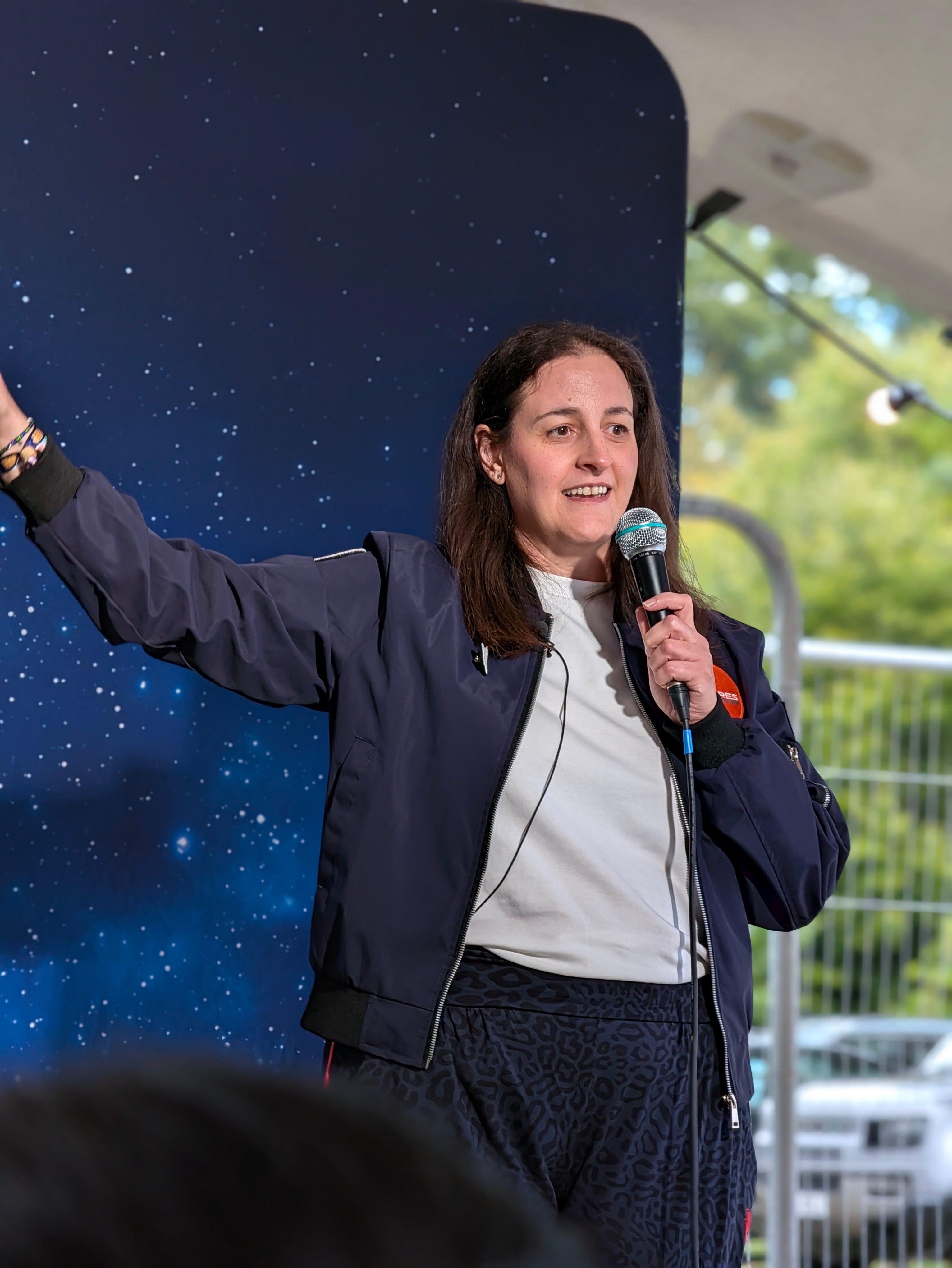
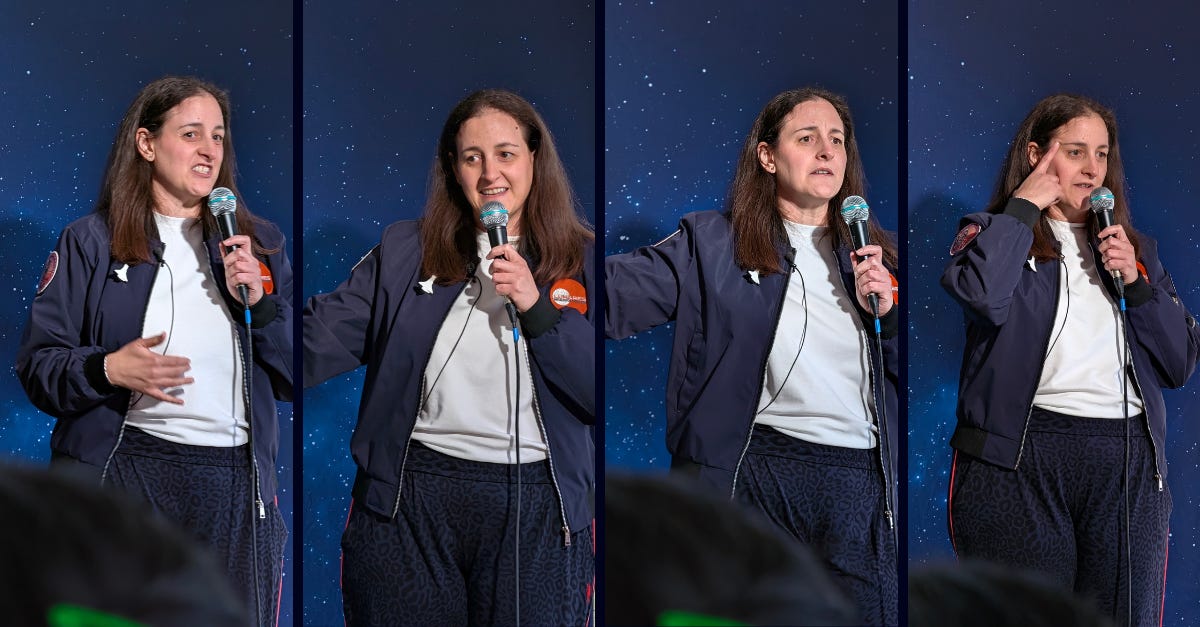
I was there to give a lightning talk in the afternoon on the Think Tank, the tent for MicDrop, which is the speaking community I’m part of run by Alex Merry. I only had 3 minutes so I knew it had to be super tight, and I didn’t want it to become ‘preachy’ — by the time people heard me they would have been there all day, minds brimming through of ideas. I wanted to leave it up to the audience to take away the most meaningful part to them, and if there wasn’t anything for them in what I was saying, that was ok too — rather than hitting them over the head with a ‘this is what you should do next’ ending (nobody wants homework after a festival!).
I planned to talk about boredom, mainly to subvert the whole concept of ideas (i.e. creativity, novelty) — one way to get to ideas is through the Default Mode Network, which is a mental state you access when you’re bored (day dreaming, auto-pilot, napping). But I also didn’t want to go heavy on the neuroscience, there just wasn’t the time.
So I approached it using a new storytelling technique I’ve learned after reading Storyworthy by Matthew Dicks. If you’ve ever been told to work on your presenting or storytelling, I HIGHLY recommend reading this book. It was a risk trying out a new technique in such a public arena, but also pretty self-contained — on the positives it was to a group of people I knew, who were rooting for me, only 3 minutes, whilst on the negatives it was on a stage, being recorded, at a festival where anybody could drop by. I used MVE to prepare — scripting, recording, rehearsing, drilling, getting feedback, all before delivering it for real on stage.
I’ll be able to share the video with you really soon (in about a week’s time), but in the meantime, here’s what people said: brilliant, nailed the storytelling, I felt like I was right there with you in the habitat. One Linkedin post afterwards: “My favourite wildcard talk was from a female astronaut who had me locked in and in awe.” I even told a joke at the end, which broke the tension in the tent and got a big laugh (another subversion of speaking norms — Freud would be proud!)
Here is the approach I took.
Homework for life
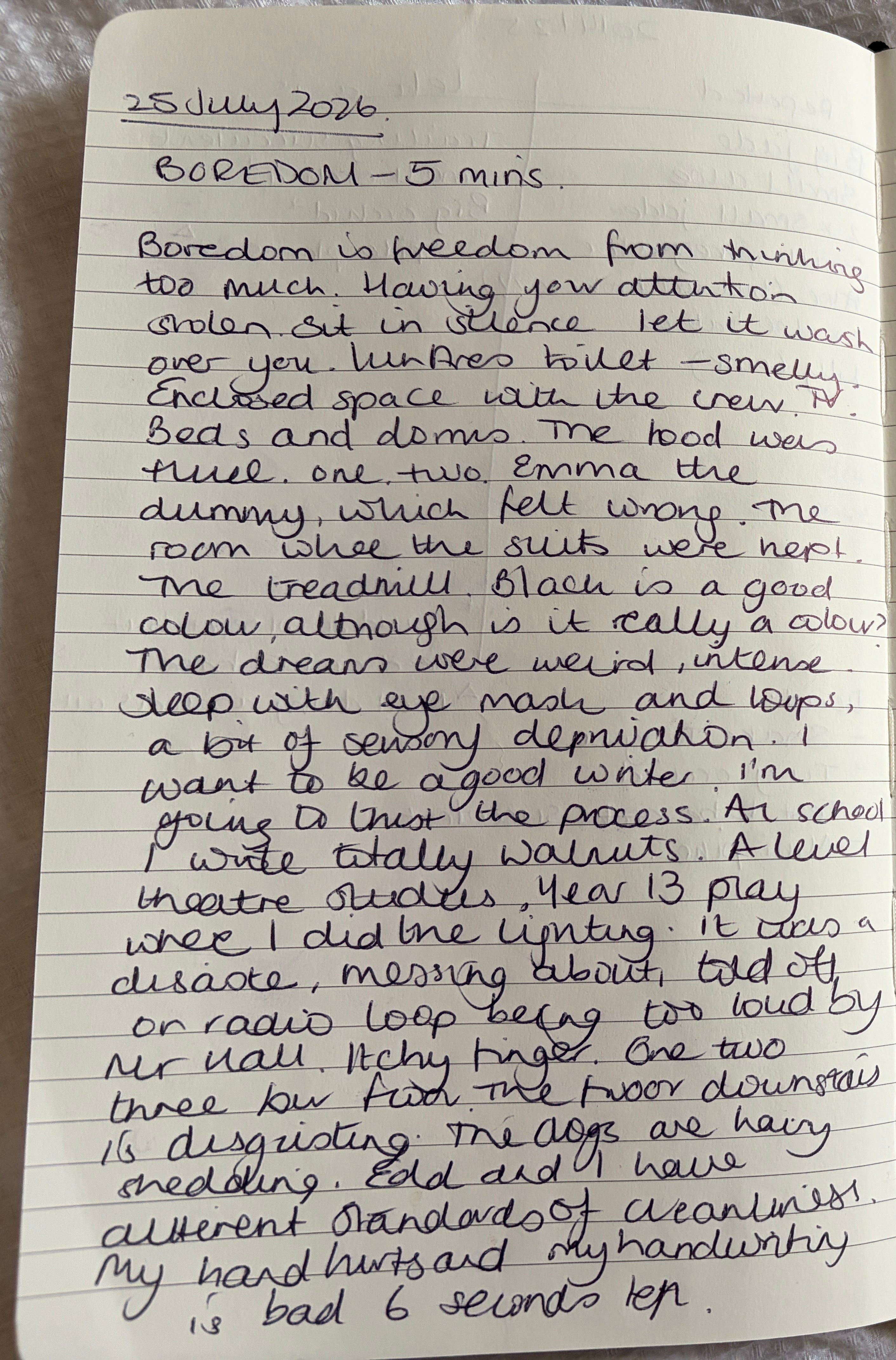
In Storyworthy, Dicks talks about taking 5 minutes every day to write down what happened. It doesn’t have to be long, just a snippet. What made today different from any other day? He combines this technique with free associative writing — setting a timer for 5-10 minutes and just writing non stop, no judgment, not allowing the pen to stop moving — to see what stories naturally come up.
I started my preparation by giving myself the prompt ‘boredom’, and set a timer for 5 minutes to start writing. When I got stuck I would start writing out numbers — one, two, three, four — until the ideas started flowing again. I did this freehand rather than typing, as I actually type fast (100wpm — I started my professional career as a touch typist), and that enabled me to match pace better with the stories.
Afterwards I looked at what I had written, and mined it for the kernels that were interesting, unusual, but entirely relatable.
5 second moment of transformation
The stories that move us most are the ones that reveal some moment of transformation. Without this, Dicks says they’re just anecdotes. The transformation is where the emotional tension comes from — think about falling in or out of love, when you discover something about another person that changes your perception of them forever, reach acceptance or sink into despair. They are small, sudden and powerful, and the complete opposite of the moment before.
I had to mine hard to find that transformation in what I had written. In fact, I struggled with this for weeks. I thought I’m telling a boring anecdote about being bored — where’s the transformation in this? I also had to take a break from everything when my dog passed away — I couldn’t look at any writing or speaking for two weeks after. I was completely devastated and not in the mood to think about work. When I came back to it, I had fresh eyes, and had a moment of inspiration. Sharing that transformation all relied on saying the same thing twice, with different intonation. On the day, it was the part I was most worried about — but I nailed it.
Start the story as close to the end as possible
Looking back at the free writing there was a lot there that was more like filler. We all know to cut the fluff, ‘show not tell’ — but Dicks specific advice to start as close to the end as possible was a game changer. Like any good action movie, I started the talk by putting the audience straight in the action with me: “It was day 3 of being sealed inside the habitat.”
I then identified which details to include to put the audience in the habitat with me, but also give the sense of boredom. I slowed down time with repetition: “Plain white walls. Plain inflatable ceiling. Plain grey carpet.” I dragged those last 3 words out when I spoke them.
Dicks also advised the story had to start with forward movement — I was going somewhere, doing something, actually moving through space. We had been on a simulated EVA, I was waiting for dinner. I was looking around for something to do. But I actually subverted this rule, because the whole point of the boredom was “I had nothing to do”. The boredom actually created a jarring stop in the action, which was kinda the point.
Raise the stakes
According to Dicks, there’s 5 ways to raise the stakes:
The elephant: the thing in the room that everyone can see, large and obvious, the need, want, problem, peril etc; this must appear as early as possible
The backpack: increases audience anticipation about an upcoming event; load it up with hopes and fears before moving story forward, e.g. suffer first then triumph
Breadcrumbs: hint at a future event but only reveal enough to keep them guessing
Hourglasses: the moment the story is about, what everyone’s waiting for, slow down; let the audience hang on every word, drag it out as long as possible, use redundant descriptions
Crystal balls: false prediction to cause the audience to wonder if it will come true
Can you see which one I used? Yep, the hourglass. But arguably there was an elephant (literally the habitat), and breadcrumbs (being sealed in said habitat) earlier in the story too.
Avoid using ‘and’
‘And’ is a terrible word in stories as it removes all the tension. Instead, use words that signal change: but, instead, therefore, except, so, yet, as a result. These create causal links in the story.
I used these liberally throughout my story, but especially to cement the five second moment of transformation (which I won’t spoil by including here!).
You may recall in my free writing I wanted to be a good writer, and I was going to trust the process.
Now I’m through the other side, I can 100% say that this technique worked for me, and it’s one I will use again and again. And there’s more that Dicks included in Storyworthy that I didn’t even get to try out yet, so there’s more to iterate on in the process for next time.
Where you can catch me speaking next:
CPO Connect - 30 September: facilitating a leadership roundtable for 90 product leaders in London (membership required - sign up here).
Agile Cambridge - 1st October: leading a workshop on using MVE to overcome your fear (use discount code 10Caroline to get 10% off your ticket)
The human side of spaceflight - 7th October: a fireside chat alongside flown astronauts and NASA’s Head of Human Research Programme, talking about the psychological challenges of sending humans to the Moon and Mars (free to join)