


Last week I was in London having lunch with my friend Jenny, who was visiting from France. We had worked together previously at a health-tech startup, and aside from reminiscing about the old days, we talked about how to navigate a company going through lots of change.
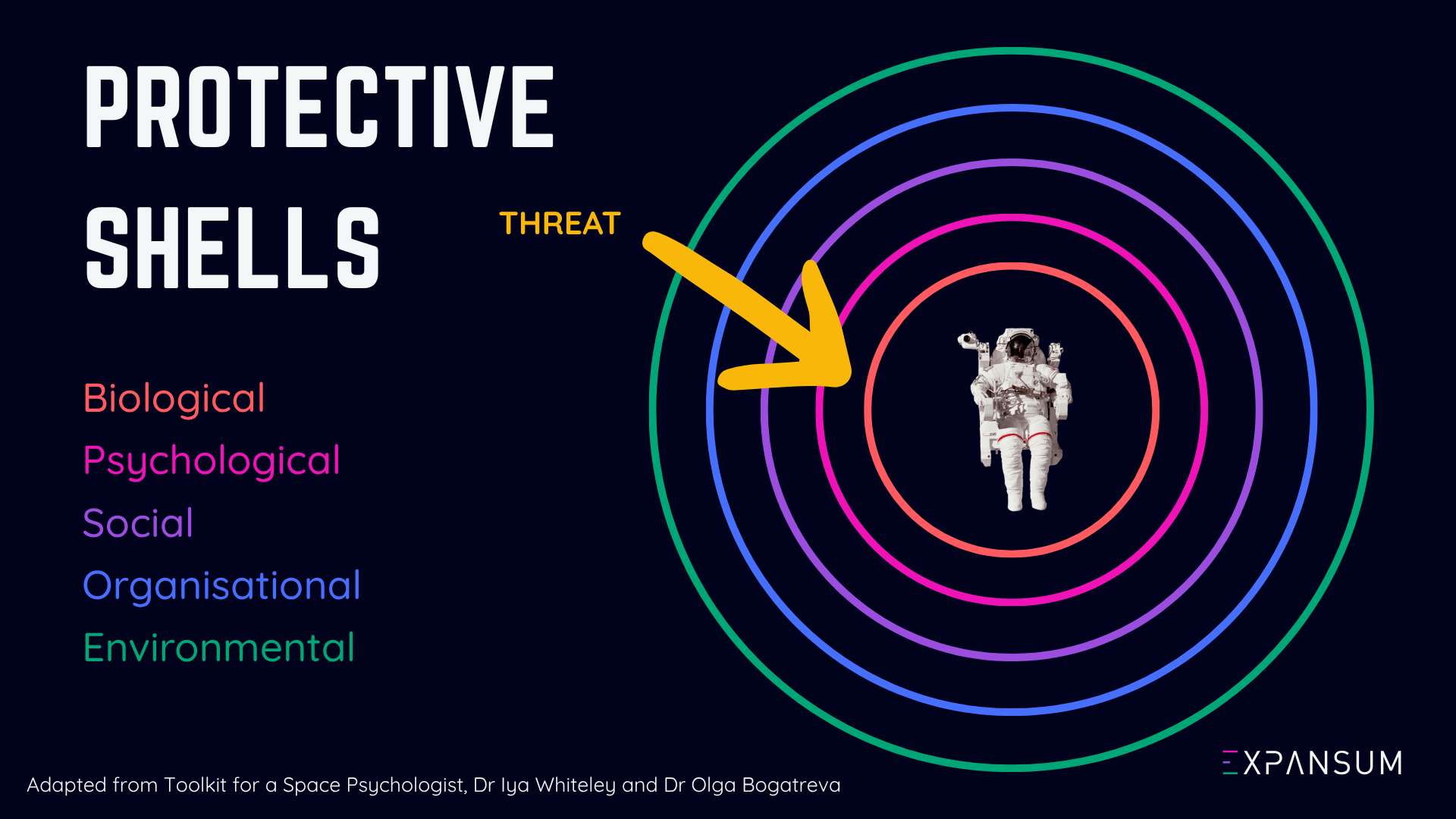
My answer? Make sure you’ve got a strong web of relationships across the organisation — up, down and across. Social resilience is one of the five protective shells, the others being biological, psychological, organisational and environmental. When the organisational layer is under threat, you need to make sure you have friends in — and out — of work to see you through.
But before I deep dive into that, let’s take a closer look at what resilience actually is and how to build it.
How do I build my resilience?
Nobody thinks they lack resilience, but we all take it for granted right up to the point where it’s tested. Psychologists view resilience not as a personal trait that you either have or don’t have. Instead, it’s a skill, and that means you can build it, and indeed should always be actively working on it. I particularly like this definition of resilience from the American Psychological Association:
[Resilience is] the process and outcome of successfully adapting to difficult or challenging life experiences, especially through mental, emotional, and behavioural flexibility and adjustment to external and internal demands (emphasis my own).
To understand this further, I’ve adapted a model of resilience from the work of space psychologist Dr Iya Whiteley and colleague Dr Olga Bogatreva: five protective shells (systems) that sit concentrically together and interact to create resilience as an emergent property.
We’re all familiar with biological and psychological — companies love to give us fruit bowls and free yoga classes to help with managing stress. We all know how important it is to have good levels of hydration, nutrition, movement and sleep. Many of us actively work on regulating our emotions, build strong routines and minimise negative self-talk. These are important, but if we only view resilience as a mindset or healthy habits then we are missing the bigger picture.
We may also be somewhat familiar with the concept of social resilience. I came across research on this shared by Bruce Daisley1 years ago and it’s stuck with me: the more social groups we belong to, the more resilient we are. If all we have are work colleagues because we’ve been hustling in our careers and working all hours to the point that leisure time is all squeezed out, then redundancy hits harder than if we’ve also been investing some of our time in playing team sports, or volunteering, or attending community meet-ups.
So social resilience is critical, and most of us intuitively know this. But what about organisational resilience? We’re aware there are things that our companies do that can either increase or decrease our stress levels. Here are the 8 factors that influence our organisational resilience:
Leadership
Autonomy
Role clarity
Workload
Recognition
Fairness
Team cohesion
Psychological safety2
Our organisational resilience can be impacted by having too much or too little of each of these. Too much leadership looks like micromanagement. Too little autonomy looks like bureaucratic decision making. Too much role clarity looks like rigid boundaries (‘that’s not my job’). Too little workload looks like boredom. The last three tend to skew towards not having enough rather than having too much.
Let’s look at a worked example for organisational resilience now — the story that I was telling Jenny, my own personal experience where it was missing.
NB: For the purposes of this post, I’m parking environmental resilience, but we will come back to it again in the future (particularly with the heatwaves hitting the UK this year — temperature is a key component as it impacts our biological and therefore psychological resilience!)
What does organisational resilience look like in practice?
I had joined this company specifically with the mission to grow B2B product from nothing to something, with my manager telling me I had full accountability and responsibility for doing so as she was going to focus on B2C. GREAT, I thought, I love having complete ownership of my work. Except there was just one problem: I didn’t get invites to key meetings where decisions were made, and instead had communications filtered through my manager as a conduit. I would give her updates to share in meetings where B2B was being discussed, yet when she was asked questions she couldn’t answer them because she didn’t have the depth of knowledge required. It made decisions slow and frustrating for everyone.
This showed me how little autonomy I actually had in practice. I suggested she invite me to those meetings so I could handle it directly. I got push back because they were broader SLT meetings which I wasn’t part of. What resulted was a vacuum of accountability — technically I had it, but couldn’t fully exercise it, without the input of SLT. It was company strategic priority #1 to grow B2B after all…
So I skipped my manager and started inviting the CPTO for coffee so I could directly update him on what was happening, get his input, and work through matters together. Should we go after everything, as our partnerships team wanted (everything meaning the NHS, Big Pharma, insurance providers, high street pharmacy, universities running studies, private practitioners, personal trainers — can you see the problem?), or should we double down on a particular segment? Should we focus on this being an API play primarily (and building out support around that) or should we build a white label front end for those partners who were less technically savvy? With a small (but mighty!) product team, we could not do everything, everywhere, all at once. Those meetings would go in, and then 15 minutes before they would be cancelled. It was incredibly frustrating to see this lack of interest from leadership.
After trying this approach a few times I decided I needed to change tack, and develop my relationships across the business.
I was already great friends with my counterpart in partnerships, who despite the over-eagerness on every Shiny New Opportunity (I do love my sales colleagues, even when they’re acting like excitable puppies!), became my best thinking partner. We would meet multiple times a week, sometimes daily, to download where we were at, where we needed to get to, and create a plan of attack for growing B2B. Sometimes this was strategy, sometimes it was therapy. More often it was a frank conversation about why he could not sell that particular thing right now, but could sell this one instead. He was in those SLT meetings, and I had more confidence my message was getting through (although I suspected always with a sales spin on it, lols).
Then he was joined by a fractional Chief Commercial Officer whose mission was to grow the partnerships team and embed strong playbooks for business development, and I saw another opportunity for influence. During his onboarding I made sure I was on his list of coffee intros, and was open about where I could do with his help. I think he respected the honesty, and pretty quickly he became another ally and champion in rooms I wasn’t in. We worked together on market segmentation, roadmap development and pricing structures. We made a lot of progress, and I learned a tonne.
Another lateral relationship I developed was Finance. I became friends with the finance manager, who was promoted to director level and started joining SLT meetings — another opportunity to influence in rooms I wasn’t in. As a side note, I strongly believe Product should always have Finance as their number 2 relationship, and what’s more, Finance bloody love being involved. It’s actually such an easy win as a product leader, to bring your two teams closer together. We worked through the ROI on products and features which helped with prioritisation, especially during quarterly planning, and developed business cases for more investment (‘if you want us to go faster, we need to hire more engineers’). In return, I understood the cost drivers of the business, which I fed back to my team. We used them as creative constraints to shape our decisions and adapted our roadmap accordingly.
In the meantime I shielded my team from a lot of the organisational bullshit. Working with the limited information and decisions shared with me, I created a vision of where we could get to with B2B — they loved it. It drew us closer together on a shared mission. It was very much framed around possibility and opportunity, even if the details weren’t all worked out. I was keen to give them as much clarity and therefore autonomy as possible, and was open about where I did not have answers, with suggestions on how we could work through that.
We engaged a lot of sense-making to start with, particularly around whether a particular feature would count as a medical device under the regulations. It was important to identify the right questions to ask, before going in search of answers. We took a very scientific approach to developing the B2B product, developing hypotheses that we would test, and this enabled us to ‘feel’ our way through the uncertainty. We also built a narrative of the mission we were on, and what each of our roles was in that. I made sure to give recognition and celebrate our successes along the way, however small: public shout outs in Slack, cakes, lunches, team nights out, giving them the afternoon off.
There was a lot I was making up for shortfalls elsewhere. I worked myself hard — too hard. I deeply cared about what we were doing because I could see the benefit to patients across the UK. I wanted us to succeed! But the workload was relentless.
I’m sad to say that this was the role where I burned out. Alongside these challenges at work, I was studying part time for my degree in psychology and dealing with some health issues (perimenopause was calling). It also meant I had little time to invest in friendships and hobbies outside of work: every waking minute was spent either working, studying or managing weird inexplicable pains in random parts of my body. Looking back now I can see how my biological, psychological and social protective shells were compromised, which ultimately compounded leading to my burnout. There was one final frustrating meeting that I couldn’t bounce back from, and I broke. I took several weeks off sick before deciding I wasn’t going back. The rest is history.
How I view resilience now: it’s not built in one single layer. It’s built across all five protective shells, and we must consistently work on each: how they interact and compound together is where true resilience lies. When change hits and one shell is compromised, the others can absorb it. When multiple shells fail at the same time, that's when we break. I didn't burn out because of one bad meeting. I burned out because my biological, psychological, social AND organisational shells were all compromised at once, and there was nothing left to absorb the impact.
Which shell/s have you been neglecting? What could you do to build your resilience today?
If you’re looking to improve your resilience right now, there’s a few ways we can work together:
Jetten, J., Haslam, C. and Haslam, S.A. (eds.) (2012) The Social Cure: Identity, Health and Well-Being. New York: Psychology Press.
Jones, J.M. and Jetten, J. (2011) 'Recovering from strain and enduring pain: Multiple group memberships promote resilience in the face of physical challenges', Social Psychological and Personality Science, 2(3), pp. 239–244. doi: 10.1177/1948550610386806.
I've included psychological safety here but with a caveat: I think the term has been so overused in the workplace that it's lost most of its original meaning — can you take interpersonal risks without fear of punishment? More on that in a future post.