


Do you feel anxious, apprehensive or even scared when called to speak in public? According to Chapman University's Survey of American Fears 2025, around a third of respondents report being afraid or very afraid of public speaking. This is more than a fear of flying, but less than a fear of sharks.
Yet being able to give a good presentation is becoming increasingly more important if you want to progress in your career. Leaders often have to stand up in front of the whole organisation to share information. Many leaders I coach mitigate their fear with thorough preparation, but that’s not always possible. How many times have you been put on the spot and asked to say a few words at the next company-wide meeting? (I know I was, many a time!)
Living alongside that fear may be a belief that ‘I’m a rubbish public speaker’. Sometimes this is our fear talking, sometimes there is early evidence that this is true — we can all think of that one presentation that didn’t go the way we wanted it to!
So how can you overcome your fear of presenting, get out of the trap of not feeling ready, and change your beliefs around your ability as a speaker?
This is where Minimum Viable Exposure (MVE) comes in. Based on exposure therapy and tried and tested through working with my coaching clients, workshop participants, and my own personal experience, this method systematically breaks down the Big Fear into a series of smaller, more manageable exposures that stretch the boundaries of what you are comfortable with. Taken step by step, it builds you up to feeling confident enough to tackle the Big Fear by the end.
In the rest of this article I’m going to walk you through how I applied MVE to giving my TEDx talk a few weeks back.
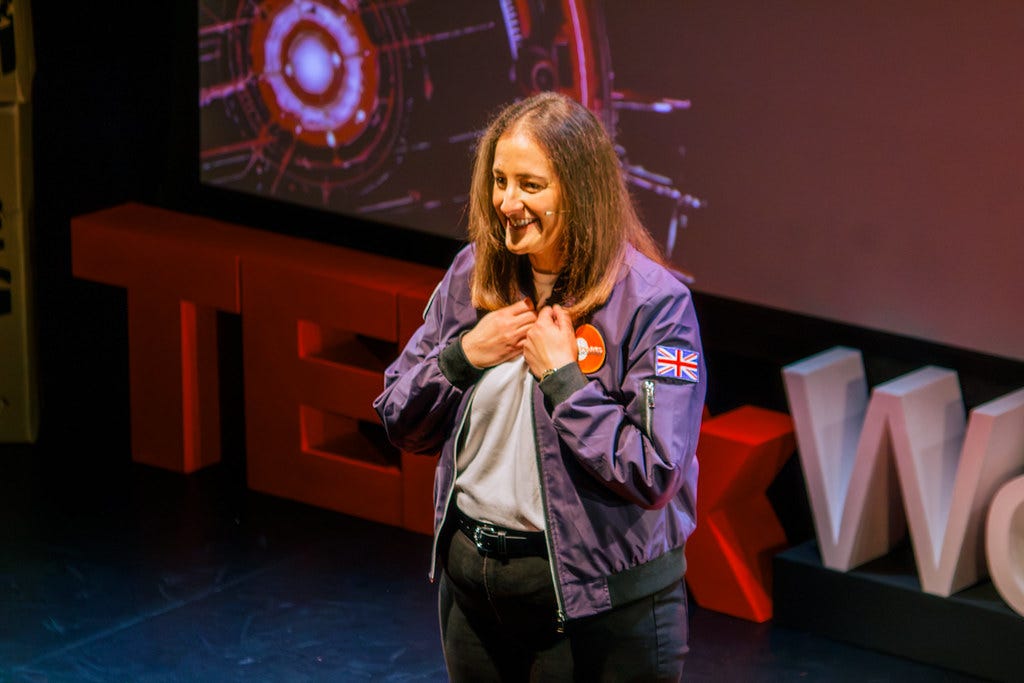
What’s the deal with a TEDx?
TED is a non-profit organisation that “believes powerful ideas, powerfully presented, move us: to feel something, to think differently, to take action”. The main brand, TED, has platformed highly acclaimed researchers, thought leaders and people with big ideas and profound experiences, like Brené Brown, Simon Sinek and astronaut Chris Hadfield. TEDx is the licensed version of TED, that enables volunteer licence holders to independently organise events to platform local speakers with big ideas. For many speakers, it’s a lifetime goal to give a TEDx talk.
Doing so comes with the following constraints:
You must have a big idea worth sharing: this isn’t a platform for self-promotion, covert selling or recycling the same old tired ideas, and getting selected involves a lengthy process of application and audition.
A time limit: you must share your big idea in less than 18 minutes (some TEDx’s require this to be even shorter, e.g. mine needed to be under 12 minutes)
No notes: the entire talk must be given without notes, either in your hand, on a device, or on a prompter in front of you.
Discourage the use of slides: a few diagrams and photos are ok if they’re necessary for the idea to be conveyed, but slides with lots of words and bullet points are prohibited (you cannot use your slides as a prop!)
You stand on the red dot in the middle of the stage and deliver your talk to an audience you don’t know, whilst it’s being recorded to then be broadcast around the world on the TEDx YouTube channel (that has 44.5 million subscribers).
No pressure then!
So how did I use MVE to deliver my TEDx talk? I broke down the task into a series of smaller steps, following what Stephen Covey says about ‘start with the end in mind’.
Step 1: Get clear on my big idea
I was clear on this from the outset: my big idea is that women should be the first humans to walk on Mars. We’ve already sent the robots there!
I worked on developing my idea with the help of my speaking coach, Alex Merry. I worked through several exercises he shared to get clear on my message and who it was for. What I was hoping is that it would open up a conversation with NASA, ESA and other space agencies — get me on their radar for potential collaborations down the line (research, astronaut training, maybe even science communication).
When I was clear on my big idea, I was ready to apply.
Step 2: Land the slot
Alex, my speaking coach and a former TEDxClapham organiser, knew it was a numbers game. He set me a challenge: apply to 10 by the end of the year. Organisers judge applications differently, some on the written form alone, some on video, some via audition, but having already done the work of defining my idea, who it was for, and why now, I was ready for whatever they asked. Six applications in, I got my first invitation to audition.
TEDxWolverhampton invited me in early January 2026. I’d already had a couple of outright rejections by then, so I really wanted to land this one. If you’ve been through a competitive promotion process, you’ll recognise that feeling: the ones you didn’t get still sting, even when you know it wasn’t personal.
Competition was tight: 196 applicants, 32 auditions, 12 spaces. I had three minutes to introduce myself and my idea, and treated it like a pitch, not an introduction. I wrote it out, timed it, and practised until it landed bang on time, a few seconds spare.
And of course, I was selected — yay!
Step 3: Get into the detail
First up was the research phase, gathering the evidence from psychological studies. Then the construction of the argument. I weaved stories from my experience as an analogue astronaut and from space history throughout. I had way more material to work with than I needed, so I had to chop a lot of detail out.
I played devil’s advocate — as an audience member with no background in space, would this make sense? I was conscious to treat the gendered leadership research as not a critique of men, but rather the system that has a narrowly defined sense of what leadership is.
Step 4: Get feedback, but use wisely
You’ll find when you’re giving a TEDx talk there’s no shortage of people with advice, and whilst well intentioned, it’s not all equal. I chose to listen to the people who had experience in this, and say thanks but disregard anybody else’s.
The organisers and Alex gave me script feedback and I evaluated that with each iteration. The most helpful feedback was how it was landing to them as an audience, because if they didn’t understand something then neither would the audience on the day. This was probably the most valuable part of the process in de-risking the content.
Step 5: Say it out loud
Reading the script out loud is a totally different experience to just reading it in my head. You can hear when the script catches — the words that are a little too heavy, a little unclear, a little difficult to get out.
In particular I had unconsciously included a tongue twister early on (“Your suit sensors are showing pressure loss - stand by for emergency protocol” — try saying that without sounding like Sean Connery!), and whilst I played around with different configurations of those words to try and break the ‘shhhh’, I ultimately ended up keeping the original and saying it slowly and enunciating properly.
Step 6: Show up to rehearsals
It helped that the organisers were very experienced, this was their ninth year running the show, with a clear schedule: eight rehearsals and four script deadlines. I blocked out time every week to work on the script early, rather than leaving it to the last minute. So much of giving the talk relied on familiarity with the material, transference into long-term memory, and that only comes from multiple exposures over time, not one big push at the end.
All rehearsals were in person, which involved a 2.5 hour journey each way from home. I experimented with the train but ended up getting stranded overnight in Birmingham coming home one night, so I opted to drive for the remainder. That meant scheduling recovery time the following morning — one night I didn’t get in until gone midnight because of roadworks and diversions!
It was important to me to show up, even though I only stood on the dot for about 15 minutes each time. I knew that if I didn’t I wouldn’t get used to saying my talk in front of an audience, seeing their reactions and hearing myself say it out loud. Each rehearsal built my confidence with what — and how — I was saying it.
Step 7: Practice, practice, practice
Early on in the process I read about Dr Jill Bolte Taylor, a neuroanatomist whose TED talk, My Stroke of Insight (about her studying her own stroke!), has garnered 30 million views. She practiced her talk 200 times before delivering it.
I thought, if it’s good enough for Jill, it’s good enough for me!
By late May, about one month out from my own TEDx, I reckon I had already practiced it about a hundred times. So in that last month I practiced it three times every single day. I recorded myself saying it, and listened to it first thing in the morning. I played it walking my dogs around the field — it was the perfect length to put on when I left the house and finish by the time I got back.
Step 8: Set your own standard for ‘good enough’
I recited my talk aiming for word perfect. Now, a lot of people say don’t do that because it will make the performance sound stiff, but I ignored them for two reasons: first it was important that I nail every single aspect of the talk, and there were a lot of facts and numbers I didn’t want to mess up and have immortalised on tape, and second I knew that if I knew my talk that well then I could inject energy into it, drawing from the live moment and the audience in front of me.
I practiced it everywhere: in different rooms in my house, in the garden, in Tesco, in the car, on trains, even in an MRI scanner when I had brain images taken (that one was noisy and it really tested my memory). I drilled the specific bits that I got stuck on, and the start and the end. I knew if I could land those the rest would work itself out.
Step 9: Sort my outfit
For some people, what they wear to give a TEDx talk is an afterthought. Mine wasn’t. Before I’d said a word, I wanted the audience to trust that I knew what I was talking about, and how I looked was part of establishing that.
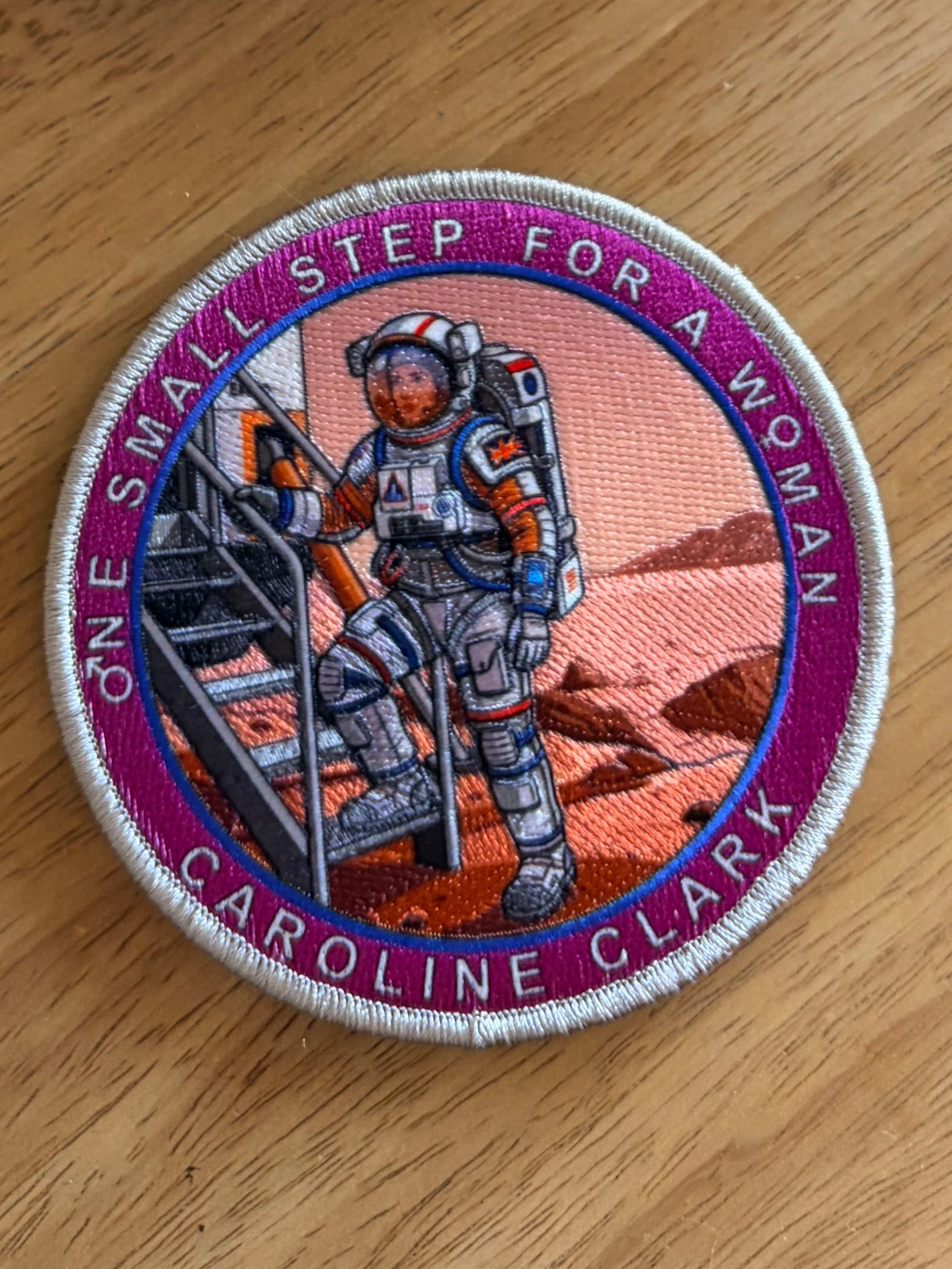
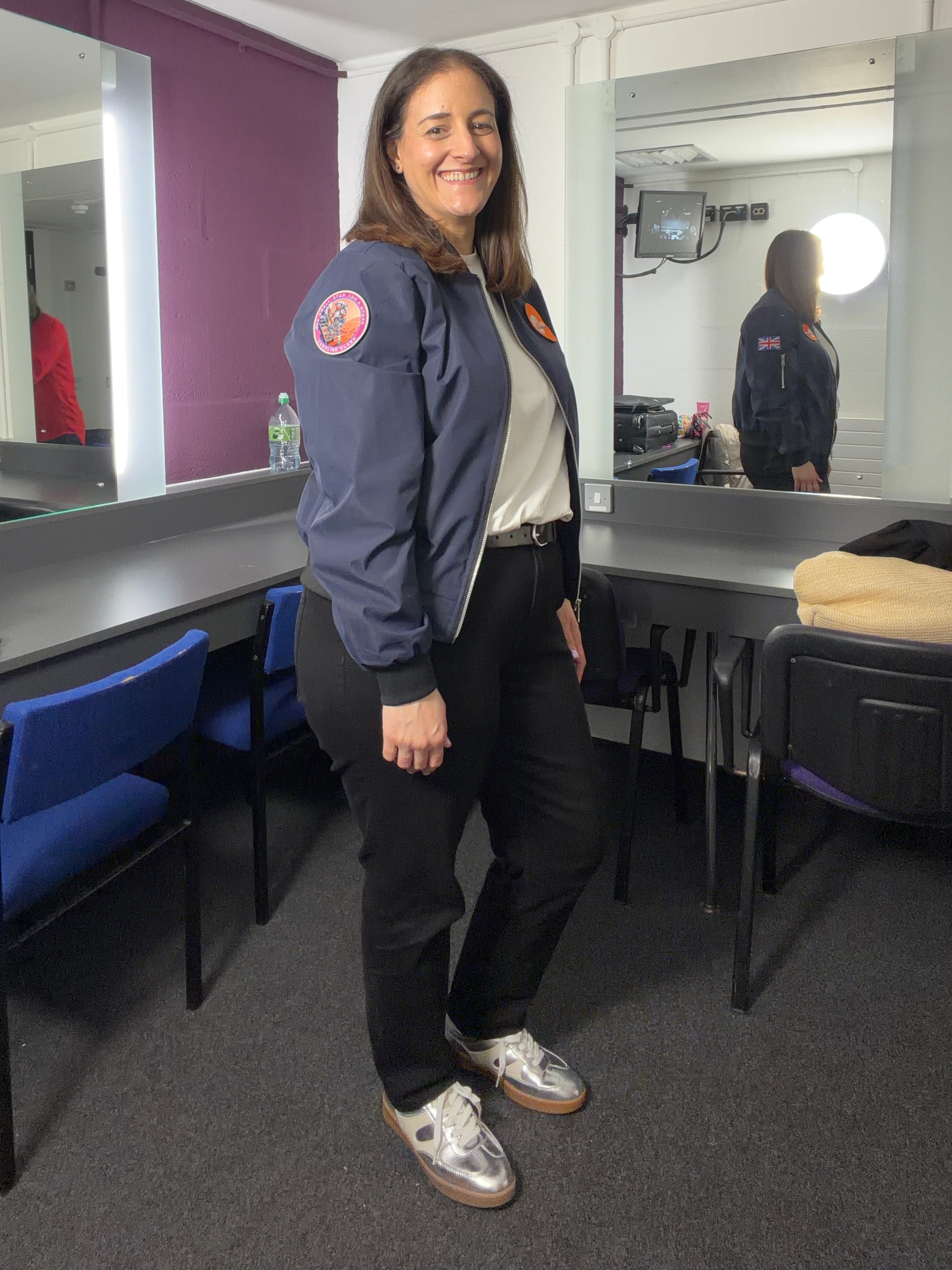
My flight suit from last year’s analogue mission wasn’t right for the stage, so I went with a flight jacket instead: something that still read as credible, without getting in the way of the talk itself.
Then I built the story I wanted my jacket to tell. I commissioned a bespoke mission patch from Tim Gagnon, who has designed patches for NASA and ESA astronauts, and paired it with my own patch from LunAres and a Union Jack. Together, they said what I couldn’t say in words before I’d even opened my mouth: I am an analogue astronaut and I know this world.
Step 10: Run my own dress rehearsal
The week before the main event, I realised I’d only ever practised live in front of other speakers, organisers, my coach, and my partner, Edd. I had a moment of panic: would it land the way I intended? So I reached out to the women in my mastermind group, who generously jumped on a call so I could run it past them.
Their reaction took me by surprise. Tears in their eyes, and one word: “brilliant.”
I needed that. Underneath the preparation I'd been carrying my own imposter feelings, worried that people already working in the space sector, people like Dr Suzanne Bell, Head of the Behavioural Science and Performance Laboratory at NASA, would question my research or my application of it. Academic credibility matters enormously to me. Their feedback didn't erase that fear, but it confirmed the argument was worthy and the story engaging, which were the other two things I needed to know were true.
(Side note: It probably also helped that in this timeframe the crew for Artemis III was also announced, which received a lot of backlash for the lack of women on the roster.)
Each of these steps built on what came before, chipping away at the belief that had been underpinning the whole process: “I’m not sure if I’m good enough for this.” As a process, MVE creates the evidence you need to invert that belief: “I am good enough, and I can do this”.
I stood on that red dot on 27 June 2026 feeling more than ready — and when I came off, I wanted to do it all again. Backstage I’d felt nervous, but it was the good kind: anticipation, not dread.
You don’t need a TEDx talk to test this for yourself. You need a high-stakes moment that scares you: the investment pitch, the All Hands meeting, the promotion panel. Using MVE, you can break it down into smaller exposures, and get your reps in.
You ‘get ready’ by doing the thing that scares you.
Minimum Viable Exposure is one of the techniques I teach in my workshop, From Burnout to Breakthrough: Resilience and Stakeholder Relationships. If your organisation is going through a lot of change, this practical workshop drawing on astronaut training techniques will show you how to build the muscles to adapt quickly and sustainably — without burning out. Book a call to find out more.