


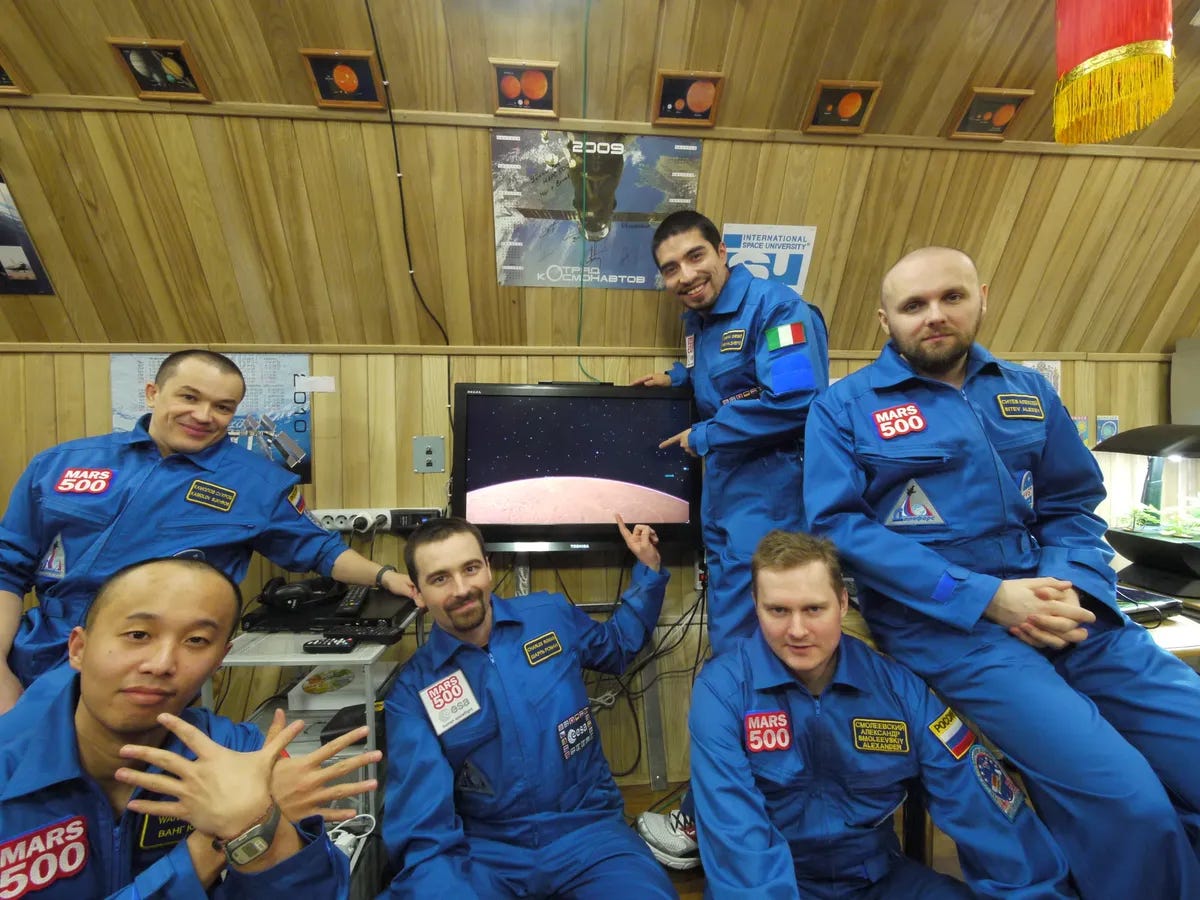
Last Friday I spoke with Romain Charles, flight engineer on the Mars 500 analogue mission in 2010. The mission involved spending 520 days in isolation, in a complex that simulated a spaceship travelling to and from Mars, plus a Martian surface where half the crew conducted space walks. He was part of a six man crew: three Russians, one Italian-Colombian, one Chinese, and of course one Frenchman.
Our conversation prompted me to research the mission, and I came across a key paper by Ushakov and colleagues1. It pointed at something the tech industry has missed: we talk a lot about wanting autonomous teams but we don’t really understand what we’re asking for.
How the tech industry defines ‘autonomous teams’
A quick Google search of ‘autonomous tech teams’ brought up Martin Eriksson’s article on Mind the Product from back in 2018: Your team is smarter than you are: why autonomous product teams work better. I remember reading it at the time and thinking ‘this is revelatory!’ — a whole new way of working where teams could work independently of others, have no need of central teams such as legal or finance, which create dependency that slows them down. Sounds great, right?
I worked in teams like this, and even set them up myself when I became a Product Director. And they do work. Having all the skills and knowledge in a single team to enable them to operate self-sufficiently means more features get shipped, faster.
Except there’s a problem with this version of autonomy: it only works horizontally. True autonomy, as the Mars 500 mission illustrates, also functions vertically, i.e. independent of leadership. Several mission parameters drove this:
A communication delay that grew from 12 to 20 minutes over the mission, including one full week with no contact at all.
No possibility of resupply once the simulated ship was beyond reach.
A crew who, the longer the mission ran, became more competent with their own systems than anyone on the ground.
This combination meant the crew couldn’t rely on Mission Control to help them in real time, and increasingly didn’t need to. Instead, they figured things out for themselves — and they didn’t always tell Mission Control afterwards.
And this principle transfers beyond the simulation. Vertical autonomy emerges whenever a team is operationally competent AND leadership is structurally unable to help in real time. You don’t need a 20-minute delay for that, you just need a team who has correctly concluded you can’t help them with the problem in front of them.
Relating this back to tech, many leaders are not (yet) willing to let go and have fully autonomous teams. Instead, we have delegation within constraints. ‘You have authority to do xyz — but no more’. That’s not true autonomy. Have you ever felt ‘caught out’ when your team solved a problem you didn’t know they had, and you heard about it from elsewhere? How did you handle that?
If you believe you need to know everything your team is working on then they’re not autonomous. And that's ok, so long as you're honest. Telling them they're autonomous when they’re not is lying to them — and yourself.
What genuinely autonomous teams need from leaders
Autonomous teams don’t want less of you — but they do want a different kind of presence. The Mars 500 crew didn't reject Mission Control entirely. What they wanted was:
Interest in what they were doing and confirmation the work mattered — this positively impacted the crew’s motivation;
Contact with family and friends, and with their national psychological support groups;
Mission Control to shift from instructive to advisory, and respond to what the crew actually asked for, not what the controllers thought they needed to know.
And this gives you a guide for how you can better lead autonomous teams.
First, being clear on the vision and mission objectives becomes the top priority. I’ll come back to Martin as he’s recently published The Decision Stack to help tech teams figure this out — well worth a read. As a leader, your job is to make sure there is absolute clarity on where you are all heading, so your teams can make their best, informed decisions on how to get there. Plenty of teams want autonomy — and leaders want to give it — but without clarity on the mission all you get is chaos.
Second is giving people the freedom to choose when and how they work — revolutionary, I know. But this isn’t a perk. Autonomous teams need a support system that isn’t you. This means time for relationships with people outside the workplace and the routines that sustain them. RTO mandates crowd these out, which means the only support structure left is… you. That’s great if you’re aiming to create dependency, not if you want autonomous teams.
Third is accepting that you won't be in the loop on everything. Not when things go well, and not when they go badly. The team will resolve problems without you, and sometimes you'll find out late or not at all. Your job becomes making sure they have what they need to decide well — and getting out of the way.
Stop parenting your team
I’ve been circling a deeper organisational dynamic in this article that I’ve seen play out in every single company I’ve worked with. You may have heard of transactional analysis, a psychotherapeutic model developed by Eric Berne in 1957. This explains how we relate to each other in adaptive and maladaptive states — Parent, Child and Adult.
Many organisations still adopt a paternalistic approach to collaboration: leaders tell teams what to work on, and whether that work is ‘good’ or ‘bad’ through feedback. This mimics experiences from earlier in childhood, and moves some individuals into a Child state, seeking approval from the Parent (leader) on their behaviour.
Limiting autonomy is what we do with children — deliberately, so they can learn safely. That instinct is appropriate to a parent, but it's not appropriate to a leader.
Yet that limitation is expressed in the workplace through delegation — we instruct teams “you are responsible for delivering this piece of work, by this deadline, with this scope, with these people”. They get positive feedback when they comply, and ‘developmental’ feedback when they fail. The hierarchy enables power to flow only when the leader chooses, and specifically over what they want to control.
And remember the 'caught out' feeling I asked about earlier? That's the Parent state activating. The hurt, the sense of being out of the loop, the urge to ask "why didn't you tell me?" — none of it makes sense in an Adult-Adult frame, where the team's silence is just an operational judgement about your usefulness to the problem in front of them. It only stings if you were unconsciously holding a parental position all along.
The Parent state is anxious. It needs to know, to approve, to feel in control. The Adult state is curious. Interested in what's unfolding, comfortable with not running the show.
Adult-Adult is a relationship between two people who are both treating each other as competent, capable, and equally responsible. Neither party is positioned above the other. Information is shared because it's useful, not because one party owes it to the other. This makes disagreement possible without threat to status, and uncertainty can be admitted on both sides. The leader brings their context and perspective as one voice in the conversation, not as the deciding one.
It would sound like “Here is your mission, I trust you to do this, I am here if you need my input” — and then get out of their way.
If that sounds difficult, here’s a closing thought: the issue of team autonomy is one that NASA, ESA and other space agencies are taking seriously, as we look to send humans to Mars in the 2030s and beyond. If the space sector can spend hundreds of billions of dollars on this mission, trusting the crew to make the right decisions in service of the mission objectives when there’s a contact delay of 44 minutes — I’m sure you can trust your team to make the right call too.
Ushakov, I. B. , Morukov, B. V., Bubeev, Yu. A., Gushin, V. I., Vasil’eva, G. Yu., Vinokhodova, A. G., and Shved, D. M. (2014) ‘Main Findings of Psychophysiological Studies in the Mars 500 Experiment’, Herald of the Russian Academy of Sciences, Vol 84(2), pp.106-114