


You have done the work. You have read the books, hired the coach, sat in the therapy room. You have identified the belief, challenged it, replaced it with something more helpful. And for a while, it works, and you feel lighter, clearer and more like the person you want to be.
And then something happens — a difficult conversation, a setback at work, a moment of unexpected pressure — and there it is again. That familiar voice, reasserting itself. “I’m not good enough.” “I don’t deserve this.” “Who do I think I am?”
It can feel like failure, like all that work counted for nothing, like you are fundamentally, irreparably stuck. But you are not stuck — you just have been working on the wrong layer of beliefs.
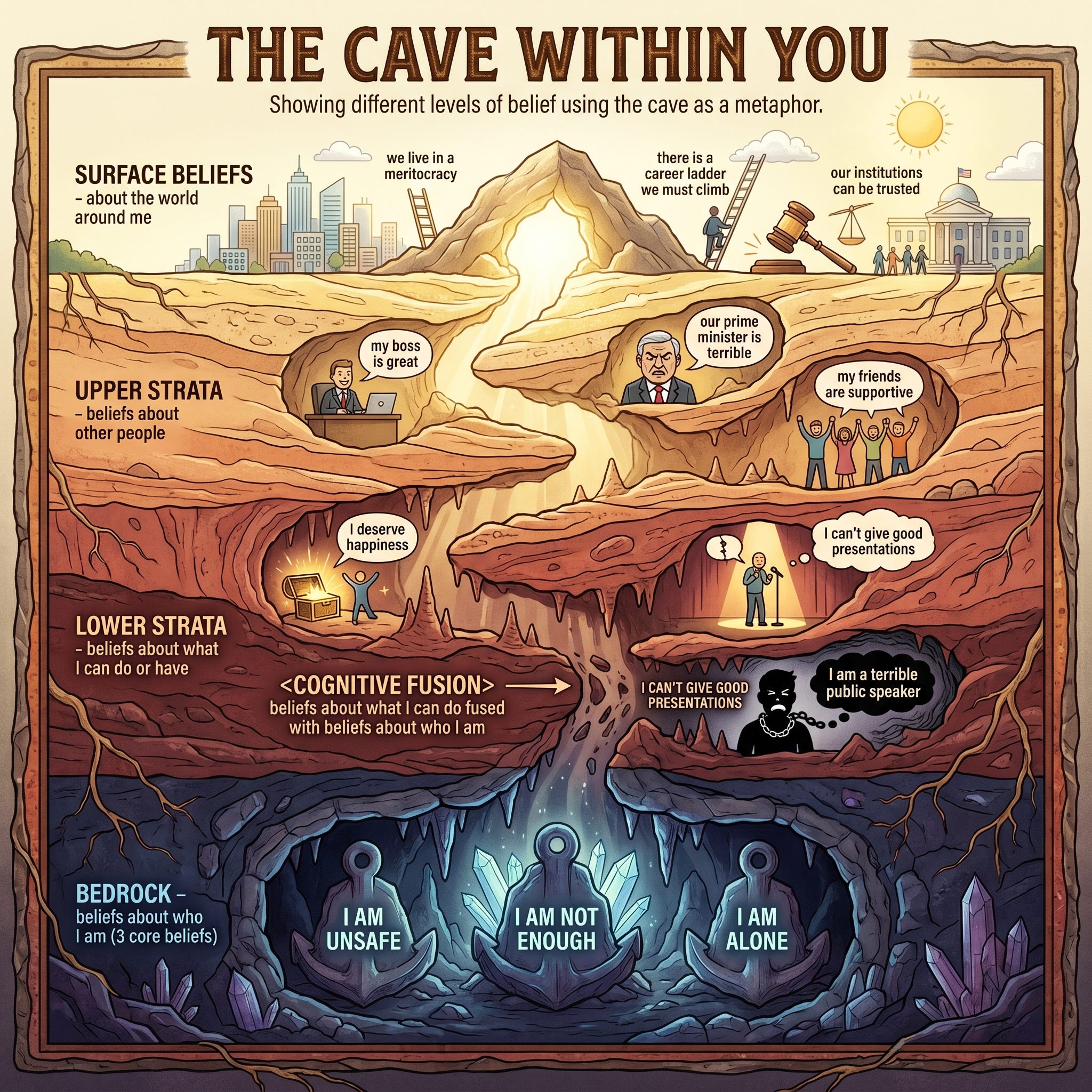
Beliefs do not exist at the same depth. Some sit close to the surface — as opinions really, that shift with new evidence and good arguments. Others are buried so deep they predate language, memory, and any capacity you had to question what was being laid down.
I want to share with you the cave metaphor that explains why some beliefs change easily, and why others seem immune to every tool you throw at them — and why that is not a reflection of how hard you have worked, or how far you have come.
The bedrock
At the deepest level of the cave is the bedrock, the foundation of all beliefs that come above it. Your bedrock is a set of beliefs about your self that is laid down early in life — within the first five to seven years during a period of high neuroplasticity in your neurodevelopment. It’s formed before you have language, a self-concept, or any mental capacity to examine what exactly is being encoded. It doesn't feel like a belief you hold — it feels like your reality.
When we shine light on the bedrock it typically reveals a combination of three core beliefs about the self:
I am not safe.
I am alone.
I am not enough.
Terror Management Theory, which was explored by Greenberg, Solomon and Pyszczynski in their 2015 book The Worm at the Core (which was itself based on earlier work by Ernest Becker) proposes that human behaviour is motivated by the fear of death. We are the only species that knows it will die, and that knowledge creates a persistent, largely unconscious terror that we manage through two belief buffers: cultural worldviews that give life meaning and symbolic immortality, and self-esteem, which functions as evidence that we are a valued member of a meaningful world. If you matter, if you are enough, then your death is not just a biological ending but the end of something important in the world.
As a result, self-beliefs are the most resistant to change. Touching the bedrock isn’t just uncomfortable, it’s existentially threatening at a level often below conscious awareness. Within several of the interviews I’ve conducted for Beliefocracy, these bedrock beliefs show up consistently, although they’re not always named or conscious.
One interviewee, a therapist who has spent years doing her own inner work (actually a requirement to become a therapist), described recognising her bedrock belief clearly, and knows where it came from. In spite of all the work she has done, it has not gone. What has changed is that she has built enough beliefs in the strata above it that it no longer governs how she behaves.
This may be the most important thing to understand about the bedrock: the goal is not to demolish it — because I’m not convinced that is actually possible. It was formed before you had the capacity to question it, and it is protected by every defence your nervous system has. The work is not excavation, but rather illumination — learning to recognise the bedrock for what it is, so that when it makes an appearance you have a choice in how to respond to it.
The lower strata
Sitting just above the bedrock are beliefs about what you can do or have. If your bedrock says you’re not enough, the layer above it might sound like ‘I don’t deserve happiness’, or ‘I can’t give a good presentation’.
Sometimes these beliefs don't stay in the realm of capability. They collapse into identity. This is what Acceptance and Commitment Therapy calls cognitive fusion — the process by which you become entangled with a thought, treating it as truth rather than as a mental event. When fused, you lose the ability to observe the belief from a distance. The thought stops being something you're having and becomes something you are. 'I gave a terrible presentation' becomes 'I am a terrible presenter.' A temporary state hardens into a permanent belief about your identity.
It is possible to change this level of beliefs — but it might take a significant rupture in your life to do that. Another interviewee shared a long-held belief that “If you work hard, you get payback, you get the right outcomes”. This was traced back to seeing his father work long hours, which he carried through to his own work ethic in later adult life. Even when he experienced burn out he still held this belief — and it caused him a lot of anxiety, a sense of feeling trapped with no way out but to return to a job that was making him ill. But then his company went through a restructure and his role was made redundant, and that single rupture — the loss of his job — was sufficient to dismantle the scaffolds that kept that belief in place, and open up other possibilities. He went on to start his own company and several years later is thriving.
The upper strata
As we climb towards the surface, next is the upper strata, which are beliefs about other people — their identity, thoughts and motivations. Sharing these beliefs publicly is risky — unless they are positive in sentiment. It’s fine to say ‘my boss is great!’, whilst ‘my boss is terrible!’ opens yourself up to judgement on your own character as well as the person you’re criticising. We share these beliefs with people we trust, or where anonymity is guaranteed — Reddit forums, culture surveys, opinion polls.
These beliefs are quickly set through ‘first impressions’, yet harder to change. There are two mechanisms that work in changing these beliefs: taking the other person’s perspective and persistent exposure.
Within my coaching work, particularly with job seekers experiencing rejections, I often ask them to imagine what it must be like to be the hiring manager: they’re stressed, doing 3 jobs at once (their day job, hiring for the role, and covering it in the meantime), under pressure to fill it quickly, and worried about their reputation if they make a bad decision. They’re looking for someone they can trust to do this job. Taking this perspective can completely change how the client sees their own CV. They may start with believing ‘my CV isn’t working’ because ‘hiring managers don’t want to work with me’ and end with clarity that it isn’t answering the killer question in the hiring manager’s mind: “is this person a safe bet that they can do the job?”
Persistent exposure is trickier, because of confirmation bias. Once you have formed a belief about a person you are going to automatically filter out any evidence that contradicts that — you will justify that evidence as exceptional, rather than normal. It therefore takes a willingness to be open and to challenge your beliefs, which is more cognitive effort. This is where the social scaffolds in particular can be most effective — it is harder to hold a negative belief about an individual when the majority of the group holds a positive one.
The surface beliefs
Beliefs at the surface concern beliefs about the world around us and how it works: you live in a meritocracy, there is a career ladder you must climb, your company will see your talent and promote without prompting. Unlike the beliefs in deeper strata, surface beliefs feel like opinions — positions you hold rather than truths you inhabit. You debate them, update them, change your mind about them over a drink or after reading a good argument (as this article is attempting!). That flexibility is itself the signal that you are at the surface. The deeper you go into the cave, the less a belief feels like something you could argue about, and the more it feels like the irrefutable ground you are standing on.
This is the level that most coaching operates on. The scaffolds holding beliefs in place at this level are the easiest to dismantle — in fact, sometimes all it takes is the coach (or another person in a position of authority or trust) asking ‘what’s the evidence for that?’ to change the client’s mind. For example, one interviewee held a belief that they could not go straight from Senior PM to Chief Product Officer, because they held strong beliefs about how to progress along a career ladder, one rung at a time. It took her husband to challenge this — “why not just ask for CPO?” to cast sufficient doubt on this belief. She did ask for CPO, an action she would never have taken otherwise.
So where does mindset fit into all this?
I hope the cave metaphor makes intuitive sense to you in explaining how some beliefs are easy to change, whilst others are more resistant. But if you’ve ever had any coaching or therapy there may be a lingering question in your mind: where does mindset fit into all this?
From the work of Dr Carol Dweck, we generally classify mindset into one of two archetypes: fixed or growth. The way that I define mindset is a general pattern of beliefs: a fixed mindset sees the individual as unable to and resistant to change, whilst a growth mindset is about flexibility and openness. In extending the cave metaphor I’ve come up with this: mindset is about the inherent quality of the rock that makes up the different layers of belief. You can liken it to basalt versus limestone: basalt is hard and resistant to change; limestone is soft and easily shaped. It’s worth noting that even basalt can be eroded over time — it just takes a lot longer.
Beliefocracy: How our beliefs govern us introduces Belief OS™ — a new framework for leaders navigating change who want to understand why lasting change is so difficult to achieve, and what it actually takes for new thinking to stick. Join the wait list to be the first to hear about publication and pre-order availability.