


This week I began interviewing people for my book, and one conversation gave me pause to review aspects of Belief OS™ — which is exactly what I want at this stage. All models are wrong, but some are useful is a mantra I’m keeping in mind — but so far as is possible I would like mine to be helpful in diagnosing and intervening when we hold unhelpful beliefs that prevent us from making the necessary change to achieve our goals.
One of my core arguments is that beliefs operate at different levels: individual, organisation, society. The challenge came from James (thank you!) who disagreed: “beliefs are always individual”. I’ve been reflecting on this since, and I’ve come to the conclusion that what he and I are saying is not actually different — rather, I think I had not been articulating what I mean by ‘operating at different levels’ clearly enough.
The unit of belief is always the individual — on that James and I agree. Beliefs originate within a human mind, as they are the lenses through which we uniquely experience the world and make sense of uncertainty.

Clarifying inter-level belief conflict
So when I talk about inter-level conflict between individual, organisational and/or societal beliefs, what I mean is this: the beliefs held by a group at large emerge from the dominant beliefs commonly held by individuals within it.
This happens in predictable ways:
Individuals are drawn to other people who share similar beliefs
The beliefs of leaders have an outsized influence within a group, and tend to be those adopted more widely
The group practices their beliefs together — through what they wear, say and do, and where they gather
Sharing beliefs is a form of social glue, and arguably vital for proper functioning as group size increases.
The direction of causality of beliefs
James shared a model from the Church of England for growing congregations: belong, behave, believe. The idea is that people need to feel they belong first, before they change their behaviour, and lastly their beliefs.
This assertion about the direction of causality is not quite correct. Psychological research shows that belief formation is actually bi-directional: beliefs may inform behaviour, and behaviour may inform beliefs. However, the evidence is clear that lasting, sustainable behaviour change requires changing the underlying belief first1. Without that, behaviour will eventually revert to whatever the underlying belief can support.
This has a practical implication for the Church of England’s model: those who don’t believe in God are unlikely to be attracted to joining a church in the first place, and even for those that do, they may not stick it out for long.
It’s worth noting that the Church has a vested interest in this particular framing. Congregation numbers have been declining for decades, and arguing that belief in God isn’t a prerequisite for belonging is a convenient response to that problem. But even if someone joins without believing in God, there is always another belief operating underneath, one they’ve perhaps never consciously examined as it’s implicit: I believe I am a good person — and belonging to this community reflects that.
The same dynamic plays out in the leaders I work with. Many come to me for support in overcoming imposter feelings that arise when making big career transitions. At the heart of this experience is a fear of being found out as inadequate. And underneath that hides the belief: I’m not good enough. Take a newly promoted Head of Product — they’ve just made the biggest and hardest career transition from individual contributor (IC), where they were measured on their own performance alone, to manager of ICs, where now their performance is measured based on their team’s. Bigger scope of impact, but less direct control over results.
They realise that the skills that helped them excel as an IC are insufficient to succeed at the next level2, and internalise this as failure. When they show up to present in an Exec meeting, that belief of not being good enough fuels a deeper feeling of not belonging — because everybody else appears to know what they’re doing, and do it well. The gap between how they see themselves, how they see their peers, and how they think their peers sees them fuels the feeling that they simply don't belong there.
So that leads us to ask: how do you change a belief?
Four steps to belief change
Drawing from other talking interventions (particularly cognitive-behavioural therapy), I’ve identified four key steps to changing beliefs. I present this as a cycle because belief change isn’t a ‘one and done’ — it’s a continuous process of iterating towards a new belief and away from an old one. It takes time and consistency. Rushing it, or just running through the actions once is insufficient.
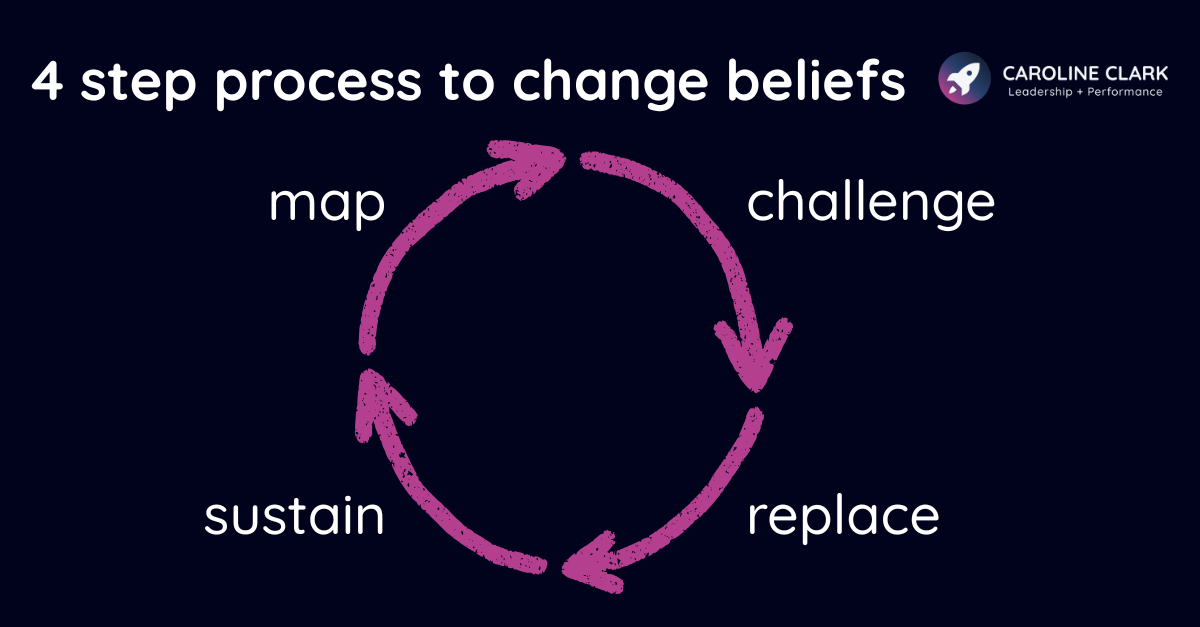
Step 1: Map the existing belief
Because so many of our beliefs are implicit, the first challenge is simply surfacing them. In coaching I listen for what clients say that reveals the belief operating underneath. People rarely announce “I’m feeling like an imposter.” What they say instead sounds more like this:
“I don’t think I can do it”, undermining their own capability.
“I’m not doing the actual work, I’m just facilitating it”, diminishing their role within the team.
“I’m afraid of coming across as aggressive”, self-policing in fear of others’ perceptions.
“Most of the points I make sound generic and obvious”, undermining their own thinking.
“I don’t think it is that big a deal”, refusing to let achievements land.
To make the rest of this process feel more concrete, let’s return to the Head of Product example from earlier. I’ll call her Maya — she’s fictional, but the patterns I’ll describe are ones I see repeatedly in the leaders I work with.
Maya is several weeks into her new role. She’s articulate about everything except what is actually going on. In one session we’re able to surface the belief sitting underneath all of it: speaking up in meetings makes me look aggressive.
Once the belief is named, we look at what is holding it in place using the Belief OS™ model. How does it give Maya a sense of meaning? What is the important truth about herself that it contains? Which social factors support this belief? How is it reinforced by her habits and routines? Understanding this gives us multiple points of intervention.
Step 2: Challenge the evidence
We hold onto beliefs, even ones that harm us, because they are also protecting us in some way. Usually they are keeping us from stepping outside our comfort zone, into the unknown, where there is a risk of danger.
For Maya, “I’m afraid of coming across as aggressive” was performing a function. It kept a constant internal vigil on her behaviour, stopping her from taking initiative, being proactive, or sharing her opinion in case she was socially ostracised. That fear kept her safe within the group by performing conformity with its unspoken norms — and not rocking the boat.
To dismantle this belief we challenge it with evidence.
What does aggression actually look like?
If it’s not aggressive, what does speaking up in a meeting really mean?
When has Maya spoken up before, and what happened?
Who does she know who speaks up well?
Would she judge them as aggressive?
What does believing that speaking up is aggressive cost her?
We’re looking to reveal the gap between what the belief claims, and what past experience and reality actually show — and from that, sow the seed of doubt that this belief is true. Only then can we begin to change it.
Step 3: Replace the belief
This step requires conscious intention. Now that Maya understands what the belief is and what it’s costing her, and is questioning its legitimacy, she can choose a different one.
The starting point is rewriting it as a positive. “I have the courage to speak up and share my point of view” helps her tap into resources she already has and can continue to cultivate.
But Belief OS™ shows us that a positive affirmation alone is not enough. The old belief is held in place by scaffolding. “I’m afraid of coming across as aggressive” may be reinforced by a dominant leader she has observed who does come across that way. He’s an influential role model, for the wrong reasons. So Maya also needs to actively find examples of people who speak up without aggression and pay close attention to how they do it. What language do they use? How do they structure their points? How do they know when it’s the right moment?
The new belief needs new evidence, new role models, and new experiences to grow from.
Step 4: Sustain the new belief
This is where consistency becomes everything. Advertisers have known for decades that repeated exposure to a message is what shifts perception over time. The same principle applies to belief change. You cannot leave space for the old belief to reassert itself. The new one needs to be reinforced continuously, through what you read, who you spend time with, and what you practice.
Maya may not go from day one believing “speaking up is aggressive” to “speaking up is good” overnight. Instead there may be a series of small, consistent shifts in her belief:
Speaking up is aggressive
Speaking up is arrogant
Speaking up is confident
Speaking up is expected
Speaking up is normal
Speaking up is good
Each step is modest, but moves her further from the old belief and closer to the new one. That is how lasting change actually works.
The challenge
When you work on changing your beliefs, some relationships will no longer fit. Not because those people are bad, but because belonging was built on shared belief. When the belief shifts, the belonging shifts too — and that can be uncomfortable enough to stop people doing this work at all.
This is where the inter-level belief conflict becomes real. Maya can do everything right: she can map the belief, challenge the evidence, replace it with something more useful, and sustain it over time. But if she’s operating inside an organisation whose dominant belief is that women who speak up are aggressive, she faces a problem that individual belief change alone cannot solve.
This is the limit of individual, 1:1 coaching, and it’s why Belief OS™ operates across all levels. The individual belief change is necessary, but without corresponding change at the organisational level, the group will keep pulling her back towards the old belief. The scaffolding of authority, belonging and shared practice will work against her rather than for her.
Changing your beliefs is hard. Changing the beliefs of the group around you is harder. But understanding that both need to change, and why, is where the real work begins.
See Ajzen’s theory of planned behaviour, and Walton and Cohen’s work on the impact of beliefs on belonging.
What Got You Here Won’t Get You There, a book by Marshall Goldsmith