


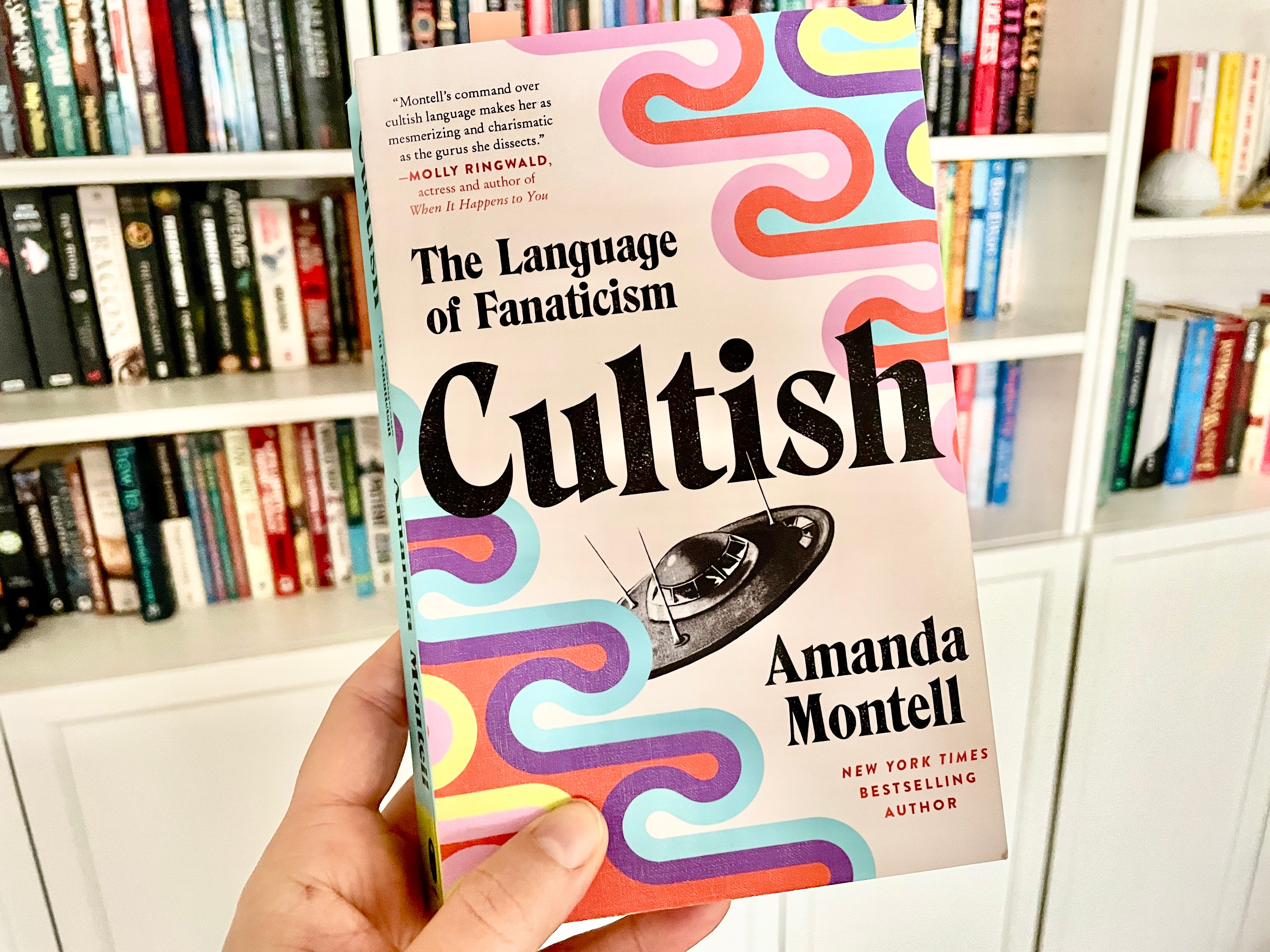
I recently finished reading Amanda Montell’s Cultish: The Language of Fanaticism. In it, she describes how language is used to construct new realities that first hook members into cults, and then keep them there.
I found myself nodding along as I read it, not least because my work researching and developing Belief OS™ has shown just how important language is as a scaffold to maintaining beliefs. What fascinates me about cults — whether we’re talking about Scientology, MLM schemes, or the current MAGA movement — is how people can maintain beliefs that directly contradict observable reality. How do people continue believing things when the evidence before their eyes suggests otherwise?
George Orwell understood this in 1984 when he wrote: “The party told you to reject the evidence of your eyes and ears. It was their final, most essential command.” That’s how powerful language is: it doesn’t just describe reality, it can override it.
The work of Lev Vygotsky, a Russian psychologist, provided the theoretical grounding for understanding how this happens. Language doesn't merely reflect our reality — it co-actively shapes it. In this article, we're going to explore how language scaffolds our beliefs, and what happens when we become conscious of the words we're using to construct our world.
What sociocultural theory says about language
Vygotsky argued that language is a psychological tool that mediates our relationship with the environment, similar to how physical tools like hammers and spears extended our capacity for action. But whilst hammers extend our hands, language extends our minds. The development of language within human society enabled us to collaborate, innovate and think creatively, imagining possibilities beyond what we observe in reality.
He writes in his 1978 book, Mind in Society: The Development of Higher Psychological Processes:
“Like tool systems, sign systems (language, writing, number systems) are created by societies over the course of human history and change with the form of society and the level of its cultural development... the internalization of culturally produced sign systems brings about behavioural transformations and forms the bridge between early and later forms of individual development” (p.7).
Language operates as a cultural tool that enables interactions between ourselves and our social world to become internalised. We learn language socially, through discussions and conflicts with others, then use it to reason with ourselves and regulate our own behaviour. Vygotsky describes this as the moment when “speech and practical activity, two previously completely independent lines of development, converge” (p.24). When this happens, “the action becomes transformed and organised along entirely new lines.”
Critically, this means language doesn’t just reflect reality — it actively shapes how we perceive and interact with it. Just as a mould gives shape to a substance, words shape our thoughts into structures.
“That’s just semantics”
This shows that our choice of words matters. Have you ever heard someone say ‘that’s just semantics’? I once worked with an executive who would deploy this thought-terminating cliche1 whenever he wanted to shut down discussion. It was his way of asserting power over a conversation, and it was exceptionally hard to challenge.
It really irked me (see: frustrated, annoyed, pissed me off, made me lose a bit of respect), because of course speech is semantics — the specific words we choose to convey our thoughts carry specific meanings for us. The Sapir-Whorf hypothesis2 supports this: it proposes that the language we speak influences how we think and perceive the world. Different languages don’t just label reality differently; they make certain thoughts easier, more habitual, or more cognitively accessible.
The evidence is compelling. Russian has separate words for light blue (goluboy) and dark blue (siniy), and research shows Russian speakers are faster at distinguishing these shades than English speakers. In another study, speakers of Guugu Yimithirr (an Australian language that uses absolute directions like north and south rather than relative ones like left and right) maintain constant awareness of cardinal directions. They literally think about space differently.
These examples are more than just linguistic curiosities: language's influence on perception has measurable real-world consequences.
Real-world consequences of language
Another example illustrating how language shapes our understanding of the world is provided by the work of Loftus and Palmer. Through a series of studies, they investigated how memory is reconstructed, including the famous car crash experiment3. Here they showed participants a series of videos of cars crashing and asked them to estimate the speed at which it happened. They asked questions with a simple word substitution as the variable:
“About how fast were the cars going when they (smashed / collided / bumped / hit / contacted) each other?”
Participants estimated the speed to be higher when using ‘smashed’ compared to ‘hit’ in the question:
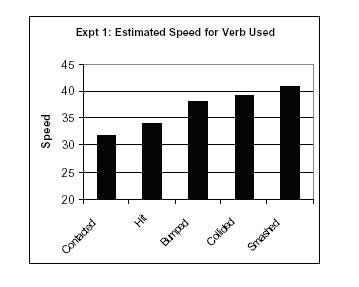
This demonstrates that language doesn't just describe memory: it reconstructs it. The word 'smashed' implies faster speeds than 'hit', which in turn feels more forceful than 'contacted'. The implications extend beyond the laboratory: when police interview eyewitnesses to road traffic accidents, their choice of words may directly influence the testimony, and therefore the outcome of investigations.
The language of neoliberalism
We are all swimming in a cult without realising it — the ideology that is neoliberalism. It is so pervasive in Western economies (particularly the UK and US) that we barely notice when its language shapes how we think about ourselves.
Neoliberalism's native tongue is the language of markets and products. What's insidious is how this vocabulary has migrated from economics into personal identity. We now describe ourselves using commercial metaphors as if they're natural, inevitable, even empowering.
Consider these parallels between economic language and how it is applied to humans:
Investing in a company → Invest in yourself through courses, coaching, self-improvement
Branding a product → Personal branding on social media
Marketing and selling → Sell yourself to employers, even romantic partners
Asset maintenance → Self-care reframed as productivity maintenance
Portfolio diversification → Side hustles, leaving no personal time unmonetised
Business development → Networking turning every relationship into a potential transaction
In case you had not yet worked it out: you are the product. And this language is actively shaping your beliefs about yourself, other people, and the world around you. I see (hear) this all the time when people say ‘I’m redundant’. The word evokes a sense of being faulty, defective, surplus to requirements — even though the reasons your role was cut have nothing to do with your ability and everything to do with short-term profit maximisation for shareholders.
This language is so ingrained in our culture that it takes conscious effort to notice it, let alone change it. You might think: “Even if I change how I talk, won’t I still believe the same things underneath?”
But here’s what Vygotsky showed us: it works the other way around. You can’t simply decide to stop believing something — beliefs are stubborn precisely because they’re scaffolded by language. Change the scaffold, and the belief loses its support structure.
So the question isn’t “How do I change my beliefs so I can use different language?” It’s “How do I change my language so different beliefs become possible?”
Changing language to change beliefs
Now we can inspect our self-talk to identify what beliefs are hiding in plain sight, determine if they’re helping or hindering us, and if the latter — change them.
Start by paying attention to one phrase you use repeatedly about yourself. Where did it come from? What belief is it maintaining? Then try a simple substitution for a week and notice what shifts — here are some examples:
“I failed” → “I learned that approach doesn’t work.”
“I have to do this” → “I’m choosing to do this”
“I’m redundant” → “My role was made redundant.”
Each revision creates a different relationship to reality. Turning failure into learning transforms a fixed state into an ongoing process. Turning have to into choosing to shifts you from victim to agent. When it comes to redundancy, separating yourself from your role reminds you that your worth isn't tied to your economic utility.
You don’t need to join a cult to have your reality shaped by language. But once you notice how language scaffolds your beliefs, you can choose to speak — and therefore think — differently.
If this resonates and you want to explore these ideas in your own leadership context, let's talk. Book a call with me.
A thought-terminating cliché is a phrase or saying that shuts down critical thinking and ends discussion or reflection. The term was coined by psychiatrist Robert Jay Lifton in his 1961 book Thought Reform and the Psychology of Totalism, based on his study of brainwashing in Chinese communist programmes and religious cults.
The Sapir-Whorf hypothesis has moderate support in psychology experiments, so must be approached with caution. Whilst it is accepted that language can influence thoughts, it is not fully deterministic, nor does it mean that we lack the ability to understand concepts for which we have no words.
See: https://www.simplypsychology.org/loftus-palmer.html