



On Friday I was down in Bristol at BANES Women's Leadership Network, delivering a workshop on overcoming imposter feelings. The theme of the event was ‘being, becoming, belonging’, and imposter feelings touch on all three. Usually I would focus on what we can do to help ourselves, but given this was a group of leaders I put a spin on it: given how common it is to feel like an imposter1, we can assume our teams are feeling this way. What can we do as leaders to help them?
I started with a shared definition: imposter feelings are the fear of being found out as inadequate. Then I introduced the cycle of imposterism. Judging by the nods and wry smiles, it resonated.
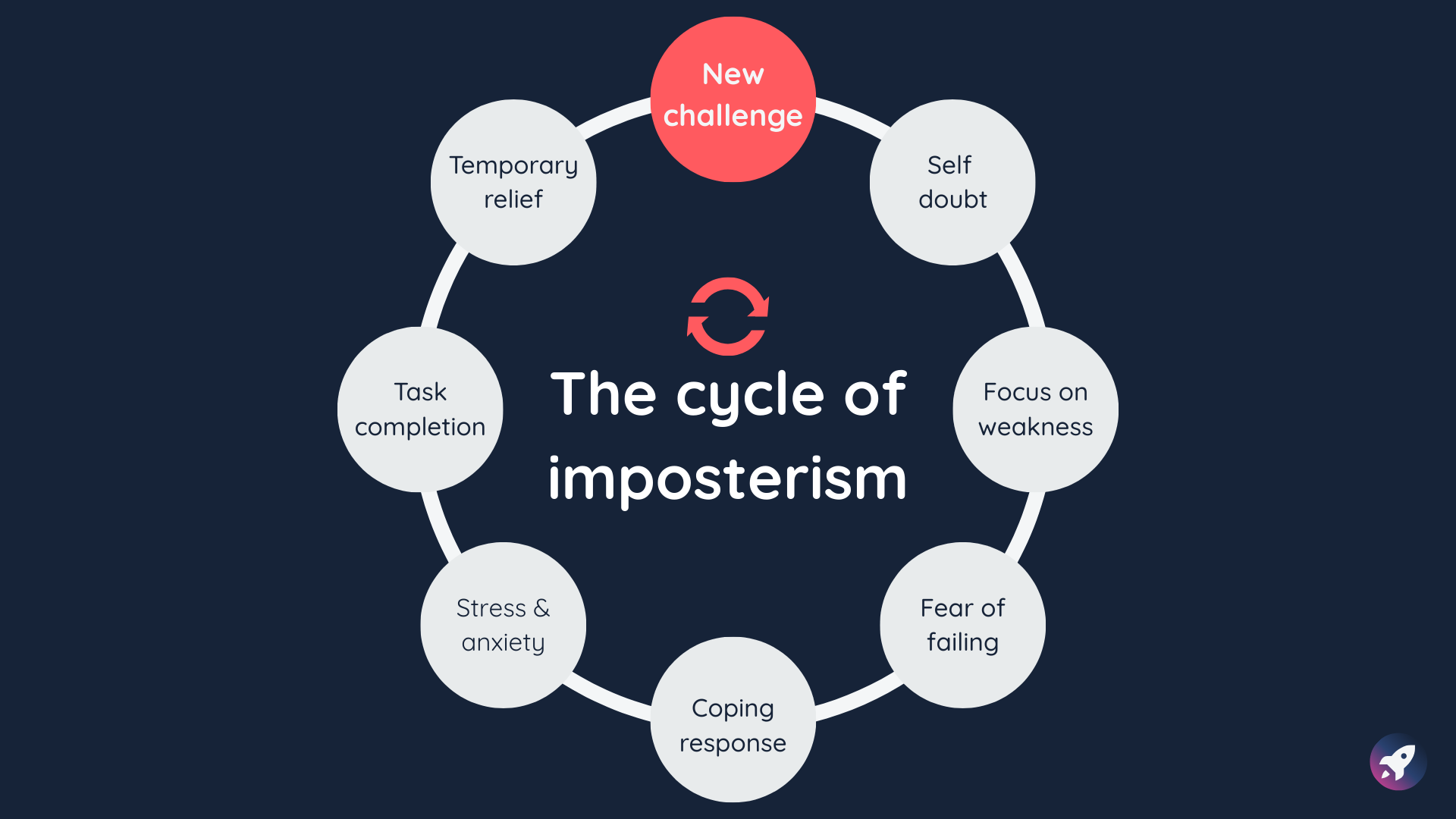
Here’s what happens:
A new challenge arrives (a promotion, a high-stakes presentation, leading a new initiative) and the inner critic pipes up. ‘I can’t do this’ plays on repeat. You focus on your weaknesses (’I’m not a good presenter, I get nervous, I don’t speak clearly’) and fear you will fail.
This leads to one of two coping responses: procrastination (waiting until the last minute, then staying up late) or over-preparation (starting immediately, putting in far more effort than necessary). The bar is already high: you’re aiming for perfection. Both lead to stress and anxiety, and those horrible 3am wake-ups.
Inevitably, you complete the task to a high standard. Colleagues may even say how brilliant it was (because it truly was). You feel temporary relief. But then the next task comes and the cycle starts again.
Understanding this cycle gives us insight into how we can break it — each point represents a place we can intervene. And not just for ourselves, but for people in our teams. Let’s look now at what we can do to help them succeed without feeling like an imposter.
How to help your teams
Let’s take each point on the cycle and explore what you can do to help your teams overcome imposter feelings.
Setting a new challenge
Recognise that stepping into an arena for the first time is going to bring up a mix of feelings, some positive, others not so helpful. For instance, if you have recently promoted a member of your team, it’s worth sitting down with them 1:1 and talking through how to make that transition successfully. Address interpersonal factors like how their identity may change — not just how they see themselves, but how others see them, particularly former peers, and how relationships will evolve. Offer support to navigate this, such as coaching them on what kind of leader do you want to be?
If it’s more task-based, like giving a presentation to a senior audience, then outlining what ‘good’ looks like can help them calibrate their expectations. Give them your insight into what’s likely to come up so they can anticipate it — if there’s a particular exec who likes to ask challenging questions, share that, and what they are actually looking for. The more information you can give them, the more reassured they will feel.
Self doubt
One of the most important things you can do as a leader is lend someone your belief in them until they develop their own. When you’re talking through the new situation or task, you can make this explicit: "I'm giving you this opportunity because I've seen how you handled [specific situation]. That same [skill/approach] is exactly what's needed here." By linking your belief to capabilities they have previously demonstrated, you are making it clear this is a natural stretch and not totally new and unfamiliar.
Normalise the self doubt: if you have your own story of how you overcame yours when you stepped up for the first time, that will force their inner critic to release its grip.
Focus on weaknesses
Set your team member up for success by calling out what they already do so well. Give them feedback on their skills, effort and approach — just be careful not to make it about them as that can have unintended consequences. This is the difference between ‘you’re a great presenter’ (draws attention to self, which increases self-monitoring and therefore degrades performance) versus ‘you communicate clearly and calmly, and break down complexity into simple to understand concepts’ (focuses on their skills and abilities)2.
Fear of failing
One powerful idea that emerged from the workshop was to encourage your team member to embrace an experimentation mindset. What is one small thing they could do to test it out? Tiny experiments enable us to reduce risk to an acceptable size, but also accept that learning does not happen without failure. This reframe works particularly well if your team member values growth and learning. For instance, instead of 'deliver the perfect presentation to the board', try 'share a customer story to bring the data to life' — and then debrief with you afterwards to embed that learning.
Coping response
This is one where you can really challenge them in a constructive way. As you set the task or challenge, and set clear expectations about what good looks like, you can also break it down into a series of milestones that you will review along the way together. If you have 4 weeks until the presentation, using the weekly 1:1 to check in on progress may help them pace themselves, as a set of ‘mini deadlines’. They also then get the benefit of your feedback as a form of external calibration, to challenge the perfectionist. Be mindful that for over-preparers, check-ins should focus on 'is this good enough?' not 'how can we make it better?’
Stress and anxiety
Watch your team member for any signs they may be feeling stress. Ask them how they’re getting on with the task outside of formal catch ups. Don’t just say ‘how’s it going?’ in passing. Create space for an honest answer. Showing you care and are available to talk about it will help dissipate those feelings, as they are more likely to arise when we feel alone, and unable to reach out.
Task completion
Once the task is complete, give timely feedback. Start by asking 'how do you think that went?' This helps them calibrate their own sense of what's good enough, rather than always looking externally for validation. Part of your role as a leader is helping them develop their own inner compass. Remember to focus your feedback on the task and what they did, not them as a person.
Temporary relief
We often quickly move on from success without taking a moment to properly pause and enjoy it. One of the most powerful things you can do as a leader is encourage celebration. Ask them ‘you did a great job there, how are you going to celebrate that?’ If it’s a big win, you could give them a more substantial recognition or reward: a company-wide shout out, a team lunch, a bonus. The point is to not just quickly assign them the next task as that diminishes the achievement and fuels the inner critic.
At the workshop, an attendee shared a striking example: at their university, academics rotate into line management roles. On Friday you’re a peer, on Monday you’re managing up to 80 former colleagues, with no training, no knowledge transfer, and no support. It’s no surprise people feel like imposters in that setup.
Imposter feelings don’t arise only from individual psychology. They’re a rational response to poor systems, unclear expectations, and lack of support. Each intervention point on the cycle is an opportunity to change that.
Start small. Pick one or two stages where you can intervene with your team this week. Notice what changes.
If any of this resonates and you're curious about how coaching could support your leadership development, I'd love to have a conversation. Book a call with me to explore working together.
Research studies I carried out last year in two different populations revealed the prevalence of imposter feelings: in the first, nearly 80% of England’s top female surgeons reported feeling like an imposter. In the second study, 96% of product people reported imposter feelings. Both studies reveal it’s not about gender, age, race, sexual orientation, or any other individual difference: imposter feelings arise in the interaction between us and our context or situation.
My psychology degree thesis examined the impact of feedback on performance in UK tech workers. Research by Dr Carol Dweck shows that praise focused on the person (e.g. 'you are a great communicator') increases self-monitoring and harms performance, whereas praise directed at effort or skills encourages repetition of that behaviour.