


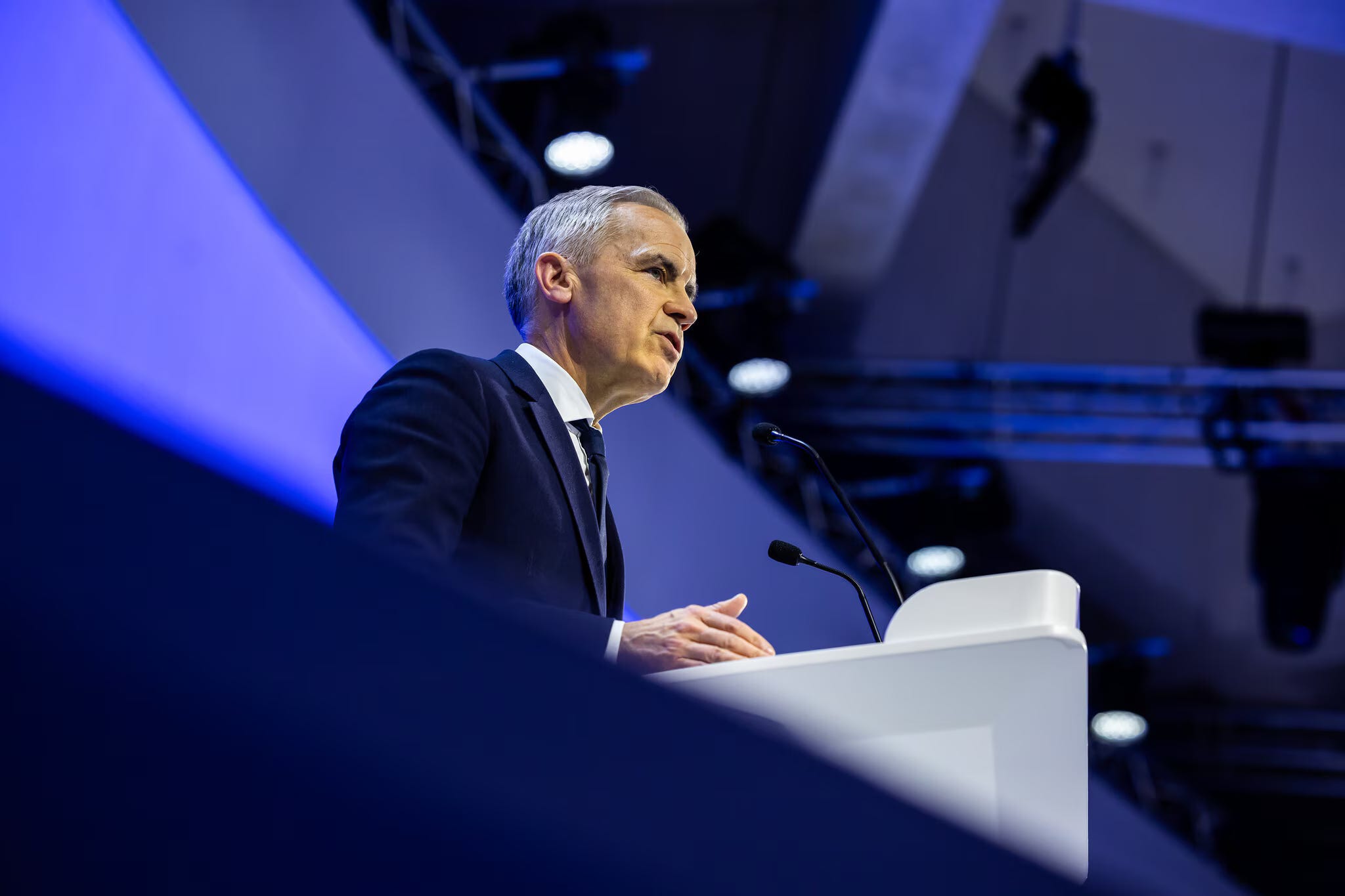
At Davos this week, Mark Carney addressed a room full of the world’s elite and political leaders to talk about Canada’s new role in the international order. It’s a brilliant speech and one that will likely go down in history as a pivotal moment, a rupture in the shared worldview. I highly recommend you read or watch (video in link) it if you haven’t already.
What struck me as I listened to Carney speak is how he addressed a need to change what we all believe about states, institutions and those who govern and legitimise them. The old belief is that rules-based international order still functions as it claims to.
The rules-based international order refers to a system of global governance in which states agree to be constrained by shared rules, institutions and norms, rather than raw power, to manage trade, security and conflict. In practice, it claims that international law applies equally to all states, regardless of size or strength.
Carney’s core argument is that it’s not just inaccurate to believe this, but dangerous to do so, because that belief leads to increased vulnerability — particularly for countries that are not great powers. Instead, he is urging us to adopt a new belief: that we are in an era of great power rivalry where rules are selectively applied.
“First it means naming reality. Stop invoking rules-based international order as though it still functions as advertised.”
In this article we’re going to explore how Carney dismantled the old belief to supplant it with a new one, using the lens of Belief OS™ (see Liftoff #27 for a refresher).
Lever 1: Meaning
We have been struggling to make sense of this for some time. We have seen with our own eyes and ears, through official news reports and social media, how certain countries have ignored the rules-based international order in recent years. From Russia’s invasion of Ukraine and subsequent annexation claims that threaten territorial sovereignty, to the US imposing unilateral tariffs on trading partners, to a UN commission of inquiry concluding that Israel has committed genocide in Gaza, we see that certain states have acted against others, disregarding a shared belief that all are subject to the same rules.
“The system’s power comes not from its truth, but from everyone’s willingness to perform as if it were true, and its fragility comes from the same source.”
Many have been living with cognitive dissonance: continuing with daily life while becoming increasingly aware of the suffering and death occurring elsewhere, sometimes not far from home. How can we make sense of this? To resolve this discomfort we create a story that the rules-based international order still fundamentally works, that the bad actors are exceptions to the norm. Carney calls out this fallacy:
“We knew the story of the international rules-based order was partially false, that the strongest would exempt themselves when convenient, that trade rules were enforced asymmetrically. And we knew that international law applied with varying rigour depending on the identity of the accused or the victim.”
The final scaffold holding the meaning of a belief in place comes in reference to Canada’s identity as a middle power, in contrast to the US, Russia and China as great powers. The rules-based international order claimed to protect all states equally, irrespective of economic size or military prowess. Carney now draws a sharp distinction between states based on size and relative power, because inequality in power and leverage has become impossible to ignore.
“Great powers can afford for now to go it alone. They have the market size, the military capacity and the leverage to dictate terms. Middle powers do not… If [the middle powers are] not at the table, we’re on the menu.”
Lever 2: Affect
Towards the end of his speech, Carney delivers a wake-up call designed to provoke strong emotions. He deliberately withdraws the comfort that has underpinned the post World War II order, naming complacency and nostalgia as risks, and replaces them with a different emotional orientation: resolve, agency and guarded hope.
“We know the old order is not coming back. We shouldn't mourn it. Nostalgia is not a strategy, but we believe that from the fracture, we can build something bigger, better, stronger, more just.”
Under the old belief, the rules-based international order was underpinned by a particular set of values. Stability was prized over disruption. Consensus and accommodation were treated as virtues, even when they limited adaptation, investment and long-term progress. There was comfort in believing that, while imperfect, the system broadly worked and would self-correct over time. But we are in a world where individual state power, not shared rules, increasingly sets the boundaries of the order, and pretending otherwise increases vulnerability to subordination.
“You cannot live within the lie of mutual benefit through integration, when integration becomes the source of your subordination.”
Under the old belief, the rules-based international order required a complementary set of morals to keep it functioning. Even when it was clear the system was not working as advertised, countries continued to go along with it, stay quiet and avoid confrontation to preserve stability. Carney uses Havel’s image of the shopkeeper who puts a sign in his window he does not believe, simply to get along (workers of the world unite). His point is that this is not morally neutral behaviour: going along with a fiction helps sustain it. Under the new belief, morals shift towards honesty and applying the same standards to everyone, rather than staying silent for convenience.
“When middle powers criticize economic intimidation from one direction, but stay silent when it comes from another, we are keeping the sign in the window… It means acting consistently, applying the same standards to allies and rivals.”
Lever 3: Social
Perhaps the biggest belief shift Carney reveals is in how control now operates. Previously, authority was vested in multilateral institutions that enforced rules states had signed up to. Under the new belief, these institutions can no longer command compliance. Their authority has been weakened as powerful states bypass rules without meaningful consequence. Authority is now determined by economic size, control of supply chains, access to capital and military strength. It is exercised through leverage, not law.
“When the rules no longer protect you, you must protect yourself… This is not sovereignty. It’s the performance of sovereignty while accepting subordination.”
Throughout the speech, Carney draws attention to how social roles are being redefined: great and middle powers, military allies (such as NATO and the Coalition of the Willing), and economic partners (including the Trans Pacific Partnership and the EU). These roles no longer guarantee protection or influence in the way they once did.
“The multilateral institutions on which the middle powers have relied – the WTO, the UN, the COP – the architecture, the very architecture of collective problem solving are under threat.”
As these roles shift, so too does a sense of belonging. It is no longer automatic or universal, but conditional and situational, shaped by shared interests and the ability to act together.
“This is not naive multilateralism… It’s building coalitions that work – issues by issue, with partners who share enough common ground to act together… That is Canada's path. We choose it openly and confidently, and it is a path wide open to any country willing to take it with us.”
Lever 4: Context
Carney makes clear that the old order was sustained through repeated rituals of participation. States attended the same summits, issued familiar statements, reaffirmed commitments — and avoided publicly naming contradictions. These rituals signalled alignment and belonging. In this context, ritual was less about belief and more about maintaining status within the hierarchy. Carney’s intervention exposes these rituals as no longer stabilising: continuing to perform them now sustains a fiction that increases vulnerability rather than security. Instead, he speaks of creating new habits:
“It’s building coalitions that work… what it’s doing is creating a dense web of connections across trade, investment, culture, on which we can draw for future challenges and opportunities.”
Language is central to how this fiction has been maintained. Carney challenges the continued use of familiar terms that imply fairness and restrained use of power: rules-based international order, shared values, mutual benefit, multilateralism. His call to name reality is an attempt to cut through the cognitive fog created by habit, euphemism and repetition. Language, in his framing, is not neutral. It either clarifies what is happening or helps sustain falsehoods that many already recognise. Even his choice to address the room as friends matters. It invokes relationship, trust and shared responsibility, while simultaneously testing whether those relationships can withstand honesty rather than reassurance.
“Friends, it is time for companies and countries to take their signs down.”
Lastly, Carney’s choice of where to deliver this speech does important work — place matters. Sharing it at Davos, before heads of state, senior policymakers, corporate leaders, investors and institutional figures, was deliberate. By naming reality in that room, Carney directs the message at those who have had the most power to sustain the old belief, challenging them to relinquish it and adopt the new.
Carney’s speech makes it clear that belief change does not happen through declaration alone. For the new belief to hold, all four levers must realign. Meaning must reflect the world as it is, not as it was described. Affect must shift away from nostalgia and false comfort towards resolve and agency. Social roles, authority and belonging must be recalibrated to match how power is actually exercised. And context matters too: the rituals performed, the language used and the places where legitimacy is asserted must stop reinforcing a story that no longer protects those who live by it. Without this coherence, the old belief will persist through habit and performance. Carney’s speech is a call to do that work deliberately, because the old belief can no longer be sustained by the evidence in front of us.