



The context in which organisations operate today is changing faster than ever before. AI, geopolitics and climate change are converging to create sustained pressure to adapt or fall behind (see #27 - The cult of overwork for more). In response, companies refresh strategy more frequently, shorten planning horizons, and restructure or retrain their teams. And yet, these efforts often fail to produce the systems-level change required to function effectively under this new reality.
Organisation-wide transformation is hard. Culture and ways of working are well established and often resistant to large-scale change. What helped the organisation maintain stability and grow incrementally when times were good is precisely what is now putting them at risk. That resistance is not individual or accidental, but structural and systemic.
This is reflected in the data. According to McKinsey, 70% of company transformations fail. Commonly cited reasons include setting the bar too low, failing to articulate why change is necessary, poor execution, and an inability to sustain momentum over time.
Leadership is often blamed, but this framing is limited. It tells us that leadership isn’t working, without explaining how or why. More importantly, it treats these failures as execution problems, rather than symptoms of something deeper happening inside organisations as change unfolds.
I have spent much of my career inside organisations navigating significant change. From public sector bodies facing austerity cuts, to startups scaling rapidly, to traditional corporates reinventing themselves for the 21st century, roughly 80% of the organisations I have worked in were undergoing transformation of some kind. These experiences have shaped how I think about why change so often stalls.
What is culture, really?
Culture is notoriously hard to define. Psychology offers many definitions, including shared beliefs, behaviours, values, and customs. In organisational contexts, Harvard suggests it’s ‘a shared set of values, goals, attitudes, and practices that characterize an organization’.
Since learning about systems thinking in the early 2010s, I’ve viewed culture as an emergent property of what you do and who you do it with: ways of working, processes, leaders and teams. More recently, through the research behind Belief OS™, I’ve come to see this definition as incomplete.
Culture is an emergent property of a system of beliefs.
Two elements matter here:
An emergent property is a characteristic that arises only when parts of a system interact as a whole. Consciousness is a familiar example. It does not exist in individual neurones, but emerges from their interaction.
A system of beliefs is not confined to what individuals think. Beliefs are sustained through social relationships, power structures, language, routines, and context.
In practice, beliefs are rarely shared uniformly across an organisation. They differ between individuals, teams, and functions. These mismatches create friction and slow progress.
Take a common example: leadership sets an organisation-wide goal to prioritise profitability and pursues cost reduction. Sales teams believe revenue growth is the safer path and are structurally incentivised to prioritise deals through bonus schemes. Product teams are pulled away from roadmaps to support those deals. Each group is acting rationally within its own belief system — yet completely at odds with each other.
The problem is not effort or alignment, but competing belief systems reinforced by incentives, language, rituals, and measures of success. As long as those reinforcements remain intact, attempts to realign the organisation through strategy decks, town halls, or new targets will snap back to the old way of operating.
Belief OS™ and organisational change
If culture is an emergent property of belief systems, then sustainable organisational change requires more than new strategies or operating models. It requires understanding how beliefs are formed, reinforced, and coordinated.
Belief OS™ offers a way to work with belief systems directly. It describes four levers for change, each supported by underlying scaffolds that shape how beliefs persist. These levers operate simultaneously across individuals, teams, and organisations, with tension arising when they pull in different directions.
What follows is a practical illustration of how this plays out.
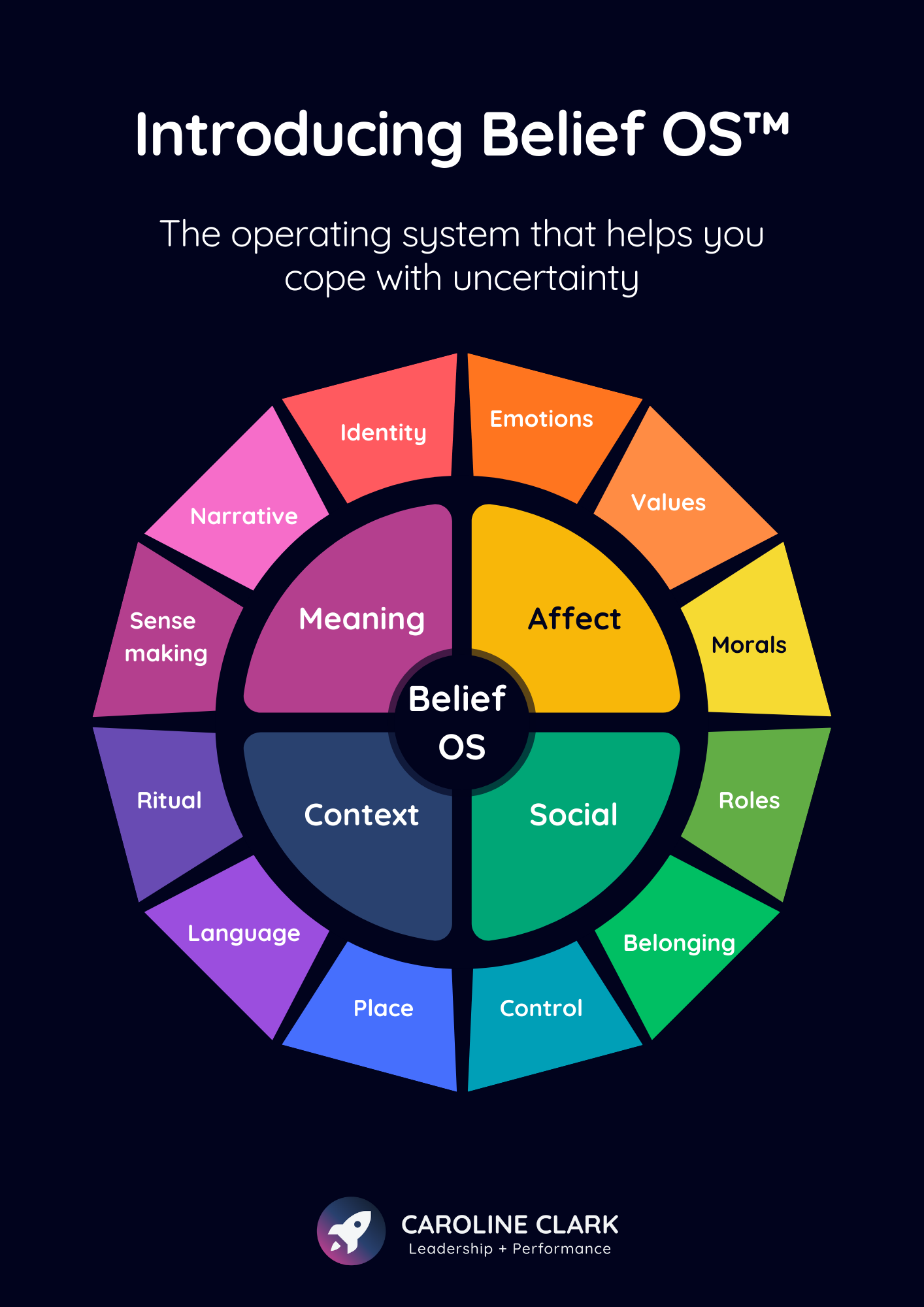
Lever 1: Meaning
Every organisation has a creation story (scaffold #1). Over time, the past often becomes idealised. The “good old days” are used as a benchmark for what the culture should be, contrasted with a more complex present. For some, holding on to the past feels safer than adapting to uncertainty.
Leaders must articulate a new, credible story of where the organisation is heading and why that direction matters now, and reinforce it consistently through decisions and behaviour.
Initially, this often creates cognitive dissonance. The new narrative may not align with the signals people receive beyond formal leadership, such as market conditions, competitors, or influential internal figures (sense-making, scaffold #2). As Leon Festinger observed, this tension is typically resolved in one of four ways:
Changing behaviour, so actions align with the new belief (e.g. if this really is the direction, I need to change what I do)
Changing the belief itself (e.g. the old way of working is no longer right)
Adding rationalisations (e.g. leadership says profitability matters, but our customers expect bespoke support)
Trivialising the conflict (e.g. we’ve heard this all before; it will change again in six months)
Only the first two lead to genuine change. The latter preserve the existing system while creating the appearance of alignment.
Over time, meaning becomes embedded through identity (scaffold #3). Change is framed through collective identities and new roles. Leaders inevitably redraw boundaries around who belongs, who is progressing, and who is left behind. Used carefully, this accelerates change. Used poorly, it fragments the organisation. Sustainable change requires the system to move forward together, not in competing camps.
Lever 2: Affect
While meaning sets direction, affect shapes how that direction is evaluated: what feels good or bad, safe or risky, acceptable or unacceptable.
Affect is shaped first by emotion (scaffold #1). Organisations develop emotional baselines over time. During transformation, fear, loss of status, and grief for dismantled roles are often underestimated. When emotions are unacknowledged, people default to instinctive self-protective behaviour, even when they agree intellectually with the change.
Affect is reinforced through values (scaffold #2). Organisations do not hold values; individuals do. What organisations publish as values are normative signals about expected behaviour. When these norms are not reflected in decisions, cognitive dissonance arises, for example, where people are told one thing matters but see another enacted. This can quickly erode trust, with dis-engagement closely following.
Finally, affect is shaped through morals (scaffold #3). Change is rarely neutral. It casts behaviours as responsible or irresponsible, progressive or outdated. If moral framing is too blunt, people protect themselves through compliance theatre, disengagement, or quiet resistance.
Lever 3: Social
If meaning sets direction and affect shapes legitimacy, the social lever determines who can act, who is listened to, and whose beliefs prevail.
One of the most visible ways this plays out is through roles (scaffold #1). Roles define not only what people are responsible for, but where they sit in the hierarchy and what they are authorised to do. During transformation, roles often change quickly. People may be promoted faster than expected, or asked to take on significantly wider remits than before. While often framed as opportunity, this can destabilise the system. A change in role simultaneously shifts status, perceived control, and identity. When accountability expands without corresponding authority, or expectations move faster than people can internalise them, individuals revert to familiar behaviours.
How people respond to these shifts is shaped by belonging (scaffold #2). Organisations are social systems made up of groups, not individuals. People orient towards those they depend on for safety, approval, and progression. During periods of change, these loyalties often outweigh formal directives. Individuals take cues from peers, alliances, and informal leaders about how seriously to take the transformation.
Belonging also shapes who feels included in the future organisation and who does not. Change inevitably signals which skills, behaviours, and identities are becoming more valued. Those who recognise themselves in that future tend to engage; those who do not may comply superficially, disengage quietly, or resist to protect their standing.
Underlying both roles and belonging is control and authority (scaffold #3). This includes hierarchy, decision rights, access to resources, and the power to define success. Control is also exercised through incentives and punishments. What is rewarded or made career-limiting teaches people what behaviour is safe. When empowerment is promised but oversight increases in practice, belief systems do not update as intended. Behaviour follows experienced authority, not stated intent.
Working with the social lever requires confronting uncomfortable questions. Who actually decides? Whose approval matters? Which groups are being elevated, and which are marginalised by the change? When these questions are avoided, they are answered implicitly through informal influence and resistance. Where meaning and affect create alignment, the social lever determines whether change is possible at all.
Lever 4: Context
If the social lever determines who can act, context determines what is repeatedly reinforced. Context is where beliefs stop being abstract and become embedded in everyday practice. It is the environment in which meaning, affect, and social dynamics are continually reproduced.
One of the most immediate ways context shapes behaviour is through place (scaffold #1). This includes physical spaces, digital environments, and how work is organised across them. Office layouts, remote tools, dashboards, and workflows all signal what matters and how work is expected to happen. People adapt to the environment they are in, not the strategy document they have read. When context contradicts intent, behaviour follows context.
Recent return-to-office mandates illustrate this clearly. In many organisations, conflict has arisen between leaders who believe the best work happens in person and employees who believe effective collaboration can happen anywhere. In practice, these belief clashes are rarely resolved through argument or evidence. Instead, they are resolved through authority: attendance is tracked and presence becomes a condition of progression.
Context is also sustained through rituals (scaffold #2). Meetings, planning cycles, reviews, approvals, and performance conversations give organisational life its rhythm. What gets reviewed, who speaks, what is celebrated, and what is ignored all teach people what the organisation really believes. When old rituals remain unchanged, they quietly reassert existing belief systems, even as new ones are announced.
Finally, context is shaped through language (scaffold #3), including texts and symbols. Language does more than describe reality; it co-creates it. Leaders can talk their teams into new ways of thinking, so long as they are clear and consistent in their message. Strategy decks, roadmaps, KPIs, jargon and acronyms, and catchphrases all shape how people interpret what is happening. Transformation can sometimes be marked by a new company logo and re-branding, batch ordering new swag, or adopting the trendy new language of Silicon Valley (I prefer Frances Frei’s ‘move fast and fix things’ to Zuckerberg’s version).
Working with context requires leaders to look beyond policy and intent and towards lived experience. What do people encounter every day? What behaviours are made easy, and which are made costly? What is normalised through repetition and infrastructure? Context is powerful precisely because it operates quietly and continuously in the background, often taken for granted.
Organisational transformation rarely fails because people are unwilling or incapable of change. It fails because belief systems are left intact while individual, fragmented pieces of the system are changed around them. Belief OS™ offers a way to see what is actually holding behaviour in place, across meaning, affect, social dynamics, and context. When leaders work deliberately with these forces, change stops being something that needs to be enforced and starts becoming something the system itself can perpetuate and sustain.