



Last year I conducted research into imposter phenomenon with two distinct professional populations: Product managers and leaders, and the UK’s top female surgeons. As part of that study I asked an open question: “What situations cause you to experience imposter feelings?” Although the jobs are very different in nature, the answers to this question were surprisingly similar.
Here’s a selection:
“New role, new company.”
“Situations where I “don’t know all answers” and actually need to educate myself.”
“When comparing to peers of similar background educational wise.”
“Presenting or in any space where I feel put on the spot to answer something.”
“Dealing with C level folk.”
“In new environments where I don't know the team and they don't know me - especially when cross site operating.”
“Conferences, meetings, putting self forward for positions.”
“Taking on leadership positions or responsibility for fear of not achieving targets that are set.”
What these demonstrate is that imposter feelings are likely to arise when we are making transitions in our career (and in our private lives, e.g. becoming parents), particularly when the stakes are high — promotions, changing jobs, taking on more high profile work like public speaking.
I know from working with clients and my own personal experience that there can be an internal monologue running that is telling us all the things we can and can’t do — which only makes the imposter feelings worse.
Though do you ever stop to listen to what that voice is really saying?
Oftentimes, there is a set of beliefs behind these statements, which is what is driving the feeling of being an imposter. Those beliefs emerge in the gap between uncertainty and certainty — their purpose is to guide us in what we do next when there’s no clear answer. For example, behind imposter feelings there may be beliefs such as:
I am supposed to already know what I am doing
I am at risk of being exposed when people more senior or visible than me are watching.
I am falling behind my peers.
And what these all boil down to is a more fundamental belief: “I am not good enough.”
(If you’ve ever felt this way, you’re not alone. 96% of Product people said they experienced imposter feelings, so it is very, very common).
Used constructively, these beliefs prompt us to work harder, demand higher standards of ourselves, and actually — just do the thing we put ourselves up for. But allowing them to get the better of us can be destructive, and bring about the very failure we so fear.
The challenge is that to change these beliefs requires more than just mindset work. As Belief OS demonstrates, beliefs are sustained not just through what we think, feel and do, but also through the people we surround ourselves with, institutions, and our environment. So let’s now apply Belief OS to imposter feelings in a worked example to both illustrate this point, and show how we need more than a single point of intervention if we are to succeed.
Exploring imposter beliefs using Belief OS
First up, I’m on the second iteration of the Belief OS model (it’s evolving rapidly!) — this version takes the mindmap and pops it into a wheel, containing four levers and three accompanying scaffolds. It’s likely not the final version yet, but it’s good enough to share. I would very much welcome feedback on this, so leave a comment below or drop me an email with your thoughts (just hit reply).
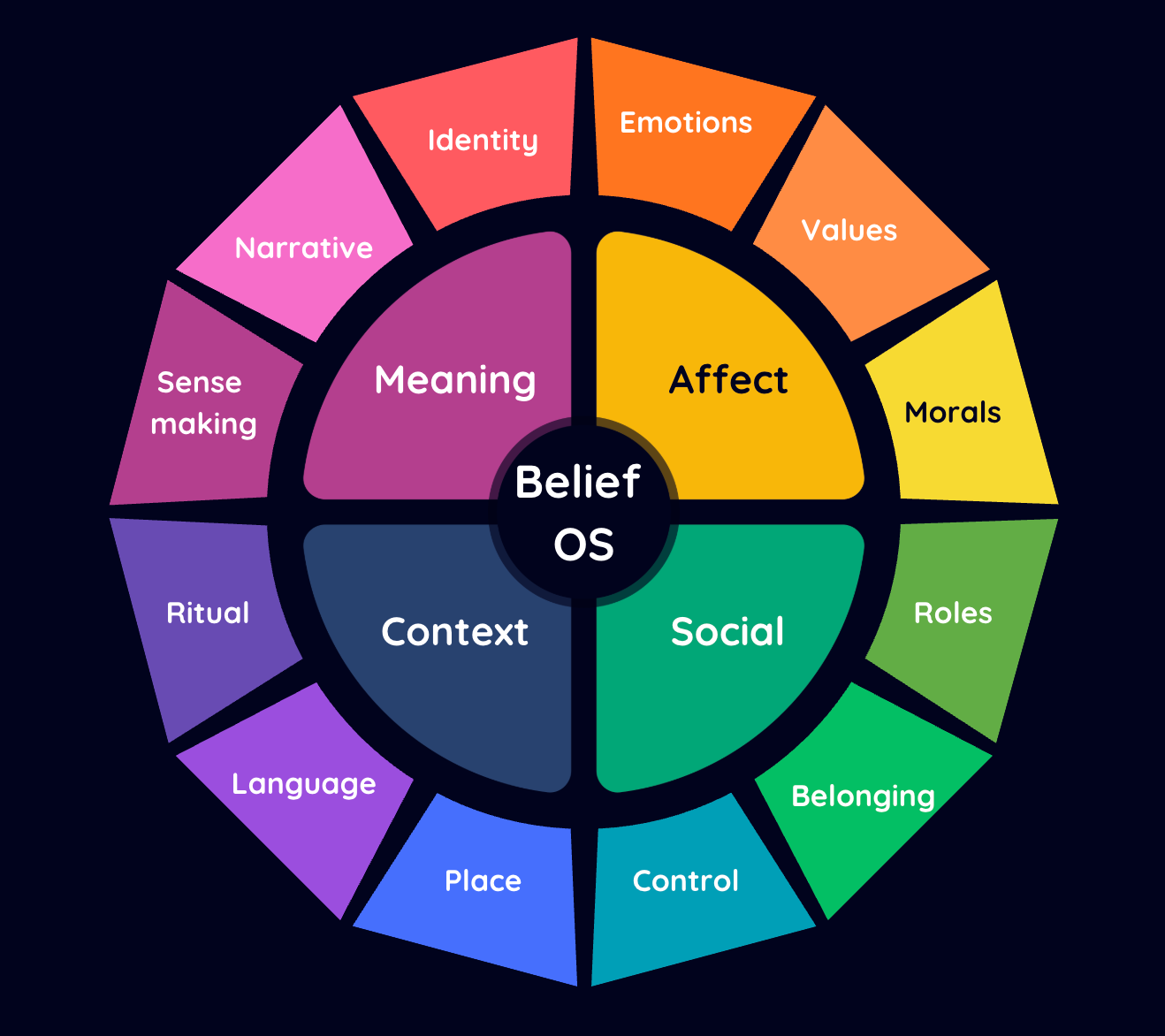
Lever 1. Meaning
What story makes “I’m not good enough” make sense?
Worldview & lenses: Competence should be obvious and effortless (the myth of ‘overnight success’); any success must be down to luck, timing, or deception rather than skill (faulty attribution bias).
Narrative & myth: The self is an impostor who stumbled into success by accident; exposure is therefore inevitable. Cultural stories of leaders as omniscient figures who have all the answers and know what they’re doing without visible effort.
Identity & roles: Real leaders don't struggle or need to learn on the job; comparison leads to realisation that you don't match that image.
This creates a coherent but false filter where personal struggle is proof of fraud, and cultural leadership myths set an impossible standard.
Lever 2. Emotion & Value
What feelings and values make this belief feel true or dangerous to challenge?
Emotions: Chronic anxiety, shame, fear of exposure, fleeting relief from "getting away with it" (the imposterism cycle).
Values, morals, ethics: Perfectionism and integrity; claiming competence feels like arrogance or dishonesty.
Emotional pay‑offs: Temporary safety from vulnerability; avoiding the terror of true responsibility or failure.
Power emotions glue the belief in place, spiking when stakes rise and making acceptance feel dangerous.
Lever 3. Social & Power
Who and what forces make this belief costly or rewarding to challenge?
Relationships and belonging: High‑achiever circles amplify comparison as everyone seems more qualified; fitting in requires downplaying genuine ability (tall poppy syndrome).
Authority and institutions: Cultures rewarding visible brilliance (corporate ladders, bonuses, promotions processes, academic testing); scrutiny from senior leaders or teachers reinforces doubt.
Sanctions and incentives: Exposure risks status loss; praise feels like pity, while humility earns social approval.
Social structures actually normalise impostor feelings as relatable or virtuous, penalising confident self‑assessment (nobody wants to be accused of being arrogant).
Lever 4. Context of Practice
Where, when, and how is this belief enacted daily?
Spaces and places: High‑visibility arenas (meetings, conferences, C‑suite settings, new teams).
Time and rhythms: Transition phases and recurring pressures (new responsibilities, deadlines, reviews).
Practices, habits and artefacts: Over‑preparation, perfectionism, rumination, reassurance loops, praise deflection.
Daily routines and habits embody and reinforce the belief through safety behaviours: working harder to ‘catch up’ yet still full of self-doubt — leading to exhaustion.
What this model shows
I have deliberately framed the four inner quadrants as levers, with the supporting elements acting as scaffolding. The levers are the parts of the belief system we can work to shift. The scaffolding is what holds the belief in place. What becomes immediately clear is that beliefs are rarely sustained by a single lever in isolation. Instead, they are stabilised by multiple forces acting together, and as a result, attempts to change a belief by intervening in just one place often meet resistance.
This is why our cultural emphasis on mindset work alone is so limited. Even if you do significant work on overcoming fear or perfectionism, or defining your values, it will not hold if you still see yourself as undeserving of the space you occupy, feel isolated or marginal within your social context, or continue to enact the same safety behaviours under pressure. Belief change is not an internal optimisation problem — it is a systems problem.
This is where I diverge sharply from the familiar advice to ‘focus only on what you can control’. That rhetoric collapses structural and relational forces into individual responsibility, placing disproportionate risk on the person with the least power. If social change had ever depended on individuals quietly adapting to existing conditions we would have no political movements, no labour rights, no civil rights, no meaningful shifts in who gets to speak, lead, or belong. The great social movements of the twentieth century were not driven by people letting go of what they could not control, but by people collectively refusing to comply with it.
When applied to imposter feelings, this mindset subtly maintains the very power dynamics that produce them. It encourages people to regulate their internal responses while leaving unexamined the social contracts, hierarchies, and norms that shape whose competence is recognised and whose uncertainty is penalised. In Belief OS terms, it removes Lever 3 from the evaluation entirely.
What often goes unexplored is that authority is rarely absolute. It rests on ongoing social agreement (as well as checks and balances). Your manager may have positional power, but you have influence by virtue of being another human being in the system, a contributor, a member of the group. As much as you want to belong to the group, so too does your boss. Influence increases when it is recognised, shared, and exercised collectively. Crucially, recognising this does not reduce personal agency, but rather expands it (see for more: Ian Burkitt).
Belief change is then not about focusing only on what you can control. It is about understanding where your beliefs are being socially and structurally reinforced, and recognising where you have more leverage than you think. Not just to act differently, but to believe differently. We will continue to explore this in future articles, including how to successfully change those beliefs that no longer serve you.
PS. I’m super happy to announce some upcoming talks and workshops — hope to catch you at one soon!
Change, By Design
On 14 January I’m running a public workshop that shows you how to put Belief OS into practice. If you’re setting ambitious goals this year and want support to achieve them, this is for you.
When: Wednesday 14 January 2026 at 12.30pm GMT
Where: Zoom - 90 minutes
BANES WLN workshop
Then on 30 January I’m down in Bristol at BANES Women’s Leadership Network, showing you how to overcome your imposter feelings. There’s a few tickets left.
Product Tank Cambridge
Kicking off the new year by sharing my talk, It’s Not You, It’s the System, at the newly formed Product Tank Cambridge on 18 February. Registration opens on 11 January here.
Product Tank Newcastle
And hot on the heels of Cambridge, I’ll be trekking up north to visit friends at Product Tank Newcastle (thanks Marie for the invite!). Keep your eyes peeled for the event details on Meetup.
PPS. The tech jobs market is shit at the moment. I believe we all have a responsibility to help each other, where we can, to find work and counter harmful narratives about AI coming for your job. That’s why I’ve opened up my job seeker course From Stuck to Hired in Product for free this December and January. It’s the backbone of what I use in my 1:1 work with job seekers (83% hired within 12 weeks of working with me), so it’s a tried and tested approach to landing your next job. Enrol for free here.