


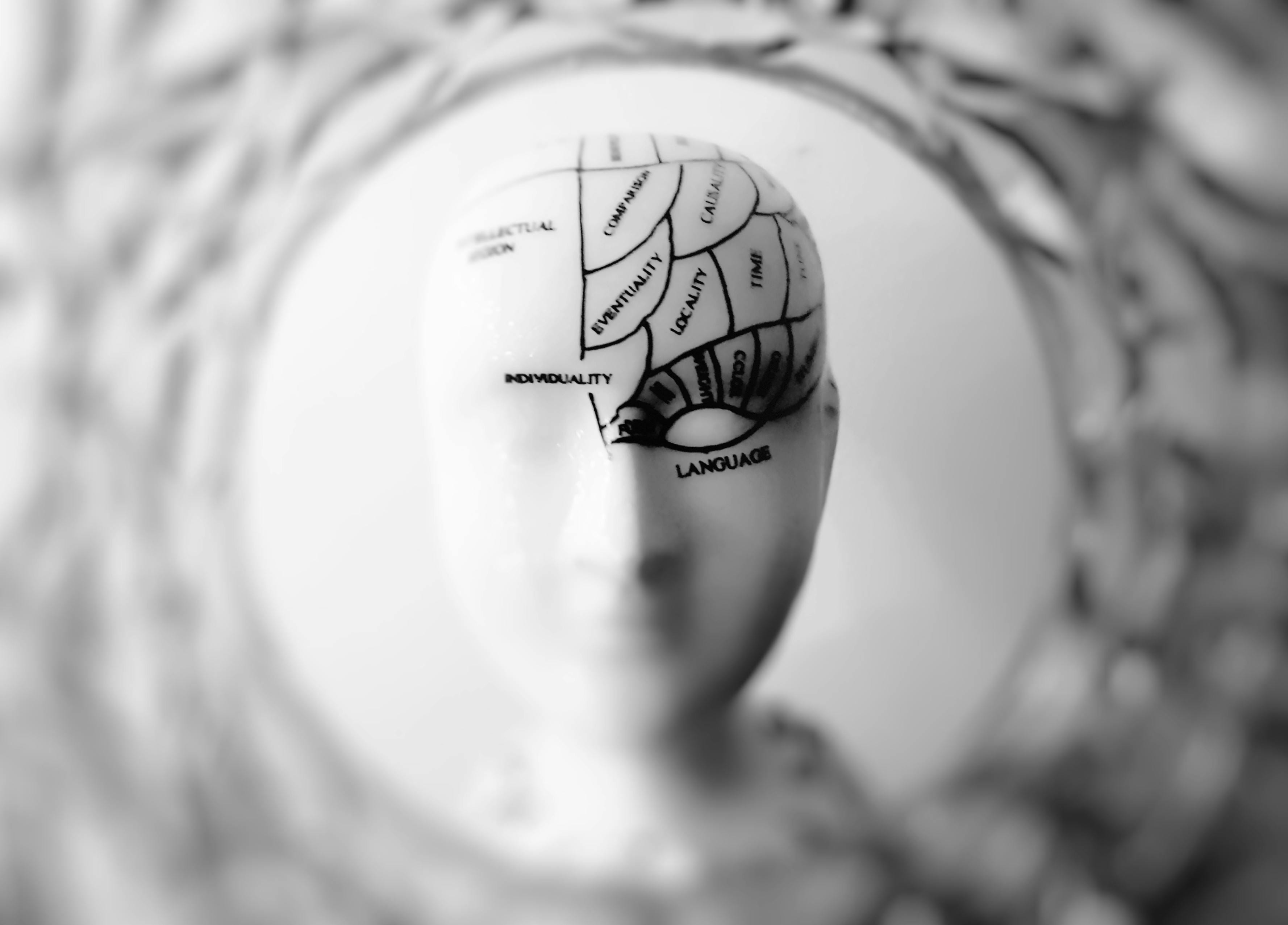
As a psychologist, I’m fascinated by beliefs: what they are, how they form, how they are sustained, how they change over the life course, what happens when beliefs go wrong — and critically — how they influence our behaviour. This fascination is the bedrock of my work: from research this year into imposter feelings (which are a form of faulty belief, prompted by a fear of not belonging), to conspiracy theorists, developing a growth mindset, and dissecting the elements of confidence (see: The Confidence Triangle).
There is an abundance of examples in the world right now that show what happens when beliefs are helpful, and unfortunately, also when they are harmful. One of my goals this year was to codify what constitutes a ‘system of belief’ — going beyond mere cognition to the social and physical structures that support the existence of beliefs. And I am going to share that now, as a model I’m calling Belief OS.
Remember: all models are wrong, but some are useful in explaining how the world works.
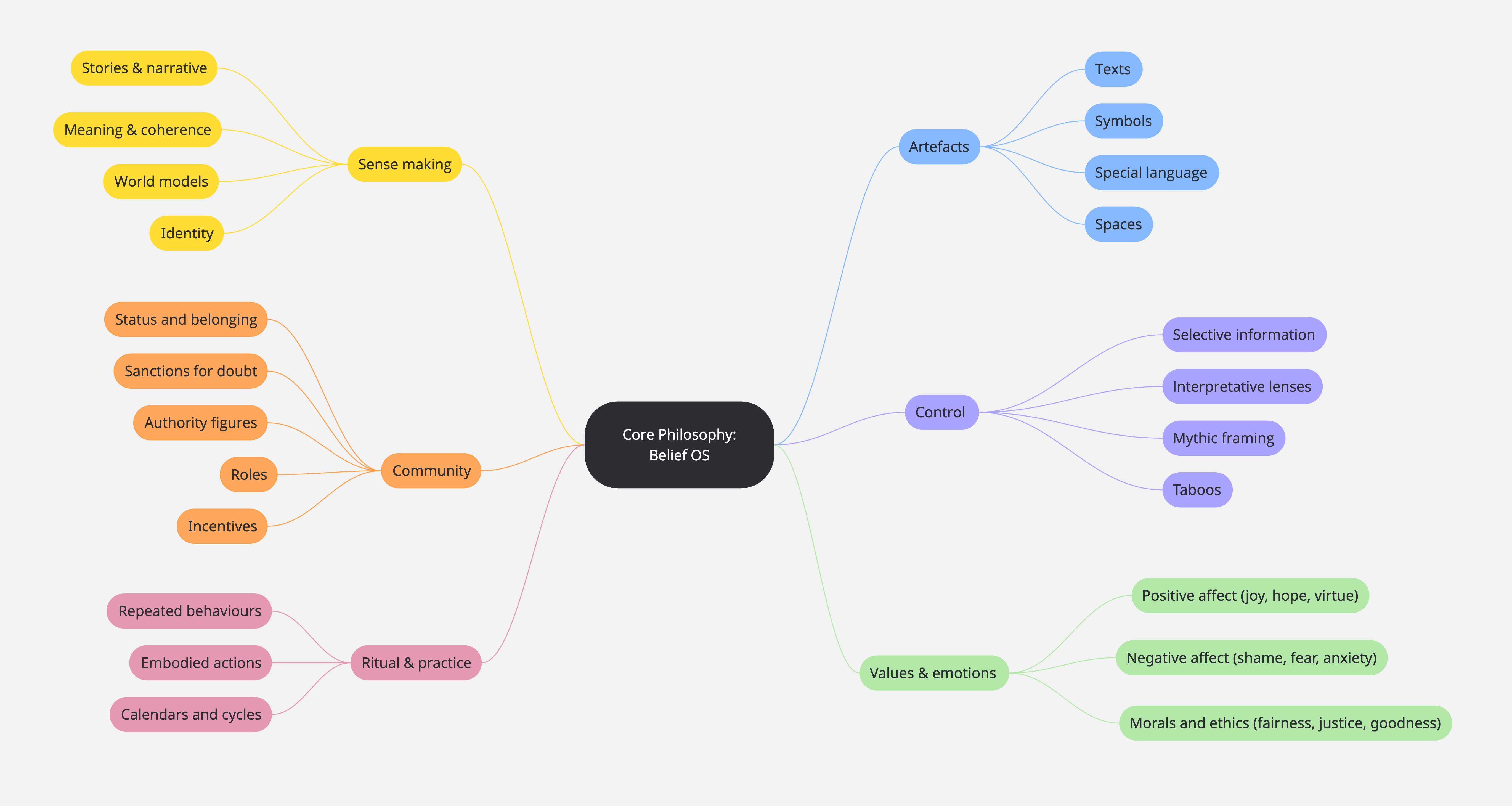
Regardless of what the belief actually is (we will use a worked example later to illustrate the model in action, although I encourage you to find your own examples — religion, political movements, economic ideologies, and limiting beliefs are the ones I’ve stress-tested this against so far) the Belief OS is the same. I’ve created a mind-map to show all the elements together, and below is an explanation of each in more detail.
Sense making
Beliefs form in childhood to help us understand our sensory perceptions, and integrate those into our personal story and autobiographical memory. We form ontological models of the world where we define, label and characterise everything around us and our inner experience. We say ‘this is hot’ when we put our hands on the radiator, because we perceive the temperature of the object we are touching and have learned the association between the parameters of the sensation and its label — giving meaning to our experiences. The challenge comes when we do not have objective evidence that could constitute actual knowledge. Here our brains have to fill in the gaps, and belief steps in to fill that space between uncertainty and certainty (see: Bayesian brain theory: Computational neuroscience of belief). Identity enters when we have a self-concept, yet feel uncertain about how others perceive us; we close that gap by believing ourselves to be ‘good’, ‘intelligent’, ‘kind’, but we don’t know that for certain — because who has the final judgement here?
NB: The vast majority of coaching falls entirely within this area of the model, especially 1:1 that focuses on ‘mindset’ work. If all your coach does is operate within these boundaries, they are highly unlikely to help you change your beliefs, because it’s simply not adequate enough to function as a systems-level intervention (which is required for actual belief change).
Community
It is a deeply human need to belong. Historically we lived in tribes, and hundreds of thousands of years of evolution won’t be undone simply by 250 years of industrialisation. In order to belong we need to understand where we sit in the hierarchy: what is my status, what is my role here, and who has the authority? This part of the model is very much about how we relate to each other. Why does this matter? Because our beliefs are influenced and reinforced by those around us (remember, it was our parents who gave us our earliest beliefs about the world). We give more weight to the beliefs of authority figures. We give more weight to beliefs of groups we want to be a part of. We have beliefs about different roles we have depending on group norms (what it means to be a ‘good parent’, a ‘good worker’).
Ritual and practice
You are what you do: the fitness fanatic who is in the gym at 6am every morning; the devout Christian attending mass on Sundays; the responsible dog owner who cleans up after their pet. Repeated behaviours reinforce the beliefs we hold about ourselves, others and the world. Embodied actions transfer what we believe from the cognitive realm into the physical, and reifies those beliefs (reification is the act of changing something abstract (e.g. a thought or idea) into something real). We live in cycles — hormones, seasons, economic boost and bust — that give us familiarity and repetition of practice, reinforcing our beliefs with regular rhythm.
Artefacts
Another aspect of the reification process of beliefs is externalising them in the physical world through artefacts. Texts are written that capture the beliefs, which ensures they have consistency in their transmission. Repetition is also key here, and short phrases (3-word slogans have proven efficacy, e.g. ‘progress over perfection’) are easily transmitted as memes across time and space. Symbols become shorthands for entire systems of belief, and help individuals quickly recognise other believers. Beliefs develop with their own special language: neologisms, labels, or turns of phrase that clarify the key elements and help with sense making and identity. Spaces become associated with beliefs, special digital and physical places where believers come to practice.
Control
For a given belief there are things that are in line with it and reinforce, and aspects that contradict the belief; it is important to exercise control, like pruning those thoughts, actions and people that do not comply with the belief’s core tenets. The Belief OS functions to restrict or attenuate certain information, and gives specific interpretation to that which is shared freely. The mythic framing creates roles that define levels of control: who are the heroes and villains. It also defines what is threat, what is virtue, what leads to success or salvation, what leads to failure or punishment. Taboos take all this one step further, by outlining not just what is forbidden behaviour, but what is forbidden thought. Consequences for a failure of belief reinforce the exercise of control.
Values and emotions
A Belief OS also tells us how we should be feeling, or at least, aspire to feel — and conversely, what to avoid and how to avoid it. Positive emotions, like joy, are to be cultivated. Virtue is to be aspired towards. Hope functions an emotion of control: if you see a better future is possible by following the belief, then you will keep it. On the flip side, the Belief OS shows us how to deal with negative emotions that we don’t want: fear, shame, anger. Through the mechanisms of control the Belief OS may also leverage these negative emotions to influence behaviour. Morals help us understand right from wrong, whilst ethics gives us a framework for deciding and acting responsibly in accordance with our morals.
A worked example
Now that I’ve described the model, we will look at how it works in practice. Much of my coaching work this year has been supporting job seekers or those transitioning into consulting work following redundancy. In this example I’m abstracting from many, many conversations and creating a representative meta belief, that is supported by sub beliefs.
Meta belief: “I am no longer competitive in a system that is moving on without me.”
Sub beliefs:
There is something wrong with me / I’m not good enough
Others are ahead of me
I can’t keep up
My role may not exist in the future
This cluster of beliefs has emerged in the gap between uncertainty (a rapidly changing and unstable jobs market in tech, fuelled by multiple rounds of redundancies and AI-hype) and certainty (having a job and feeling valued for it).
Now let’s apply the model to understand how this belief formed, and is then sustained:
A job seeker in tech is repeatedly exposed to rejection or silence from applications, while simultaneously observing peers announce new roles on LinkedIn and consuming AI-hype content predicting widespread job displacement. From these sensory inputs, they construct a world model in which the jobs market is shrinking, unfair, and increasingly precarious. Meaning is made through contrast and triangulation: others’ success becomes evidence of personal inadequacy, while AI narratives are fused with rejection to infer that opportunities are already disappearing. Over time, identity shifts from ‘experienced professional’ to ‘job seeker’, and then to something more stigmatised: long-term unemployed, an economic statistic, or a casualty of technological change.
This belief is then stabilised socially and structurally. Losing the ability to participate through work erodes belonging to the tech industry, while the drop in status from skilled, high-earning work to unemployment constitutes a direct threat to self-identification. Authority figures such as industry experts and influencers reinforce elitist narratives about ‘rockstar’ talent and survival of the best, equating employment with worth. The system is reified through rituals and artefacts: endless applications, CV optimisation, interview rehearsal, job descriptions, rejection emails, and applicant tracking systems all encode narrow definitions of acceptability. Symbols like job titles or ‘open to work’ badges, special language about ‘high bars’ and ‘future-proof skills’, and exclusion from offices, Slack channels, and events physically and socially reinforce the sense of falling out of the system.
At the same time, the belief system polices itself. Structural explanations such as hiring freezes, budget cuts, or recession are filtered out, while rejection is interpreted as evidence of personal deficiency. The job market is framed mythically as a meritocratic arena where heroes hustle and the weak fall away, making expressions of despair or criticism feel taboo and risky. Shame, fear, and envy regulate behaviour, keeping the individual striving, visible, and compliant, while hope is sustained only through further optimisation. Morally, employment is treated as virtue and unemployment as failure; ethically, responsibility for survival is placed entirely on the individual, obscuring how risk has been systematically shifted away from organisations and onto workers.
When beliefs are sustained this way, mindset work alone is never enough. The next step is to understand how to intervene across the Belief OS to create real, durable change.
In the next article, I’ll explore what it actually takes to change beliefs like this, and why interventions must operate across the whole system rather than just in the mind.
PS. The tech jobs market is shit at the moment. I believe we all have a responsibility to help each other, where we can, to find work and counter harmful narratives about AI coming for your job. That’s why I’ve opened up my job seeker course From Stuck to Hired in Product for free this December and January. It’s the backbone of what I use in my 1:1 work with job seekers (83% hired within 12 weeks of working with me), so it’s a tried and tested approach to landing your next job. Enrol for free here.
Regarding the article, my Pilates instructor always stress-tests my Belief OS.
The example at the end felt eerily familiar. I find it super interesting how you systemise this and it makes so much sense.