


I’ve been sick for the past week with Covid, and whilst I’ve not been able to work that hasn’t stopped me from thinking about work. One of the tasks I wanted to complete before the end of the year was reflecting on what I’ve learned from my work this year, with a view to crystallising these insights into some sort of framework that can help my clients moving forwards. Lying in bed for three days gave me that opportunity — and here I’m going to try and jot down the key points so I can test these ideas out with others people.
So how do all the different threads of my work weave together? Looking back at this year there are several strands, and at first glance it can be hard to see how they all relate to each other:
Space psychology (how astronauts deal with the psychological stressors of living and working in space)
Extreme jobs
Resilience and high performance
Belief change > behaviour change
Women in [product] leadership
Imposter feelings
My future masters in Organizational Psychology at Birkbeck
My ultimate goal is to create a framework that I can use in client work now, but which paves the way to my future working with the big space agencies and training astronauts. I was beginning to think these were two separate goals that weren’t reconcilable. Short versus long term thinking — my journey to work in space is on a ten year trajectory, whilst my business is still very much focused on quarter by quarter!
But when I dug deeper there was a common strand across all of these, and it’s to do with how we as humans work together to achieve common goals. How we organise ourselves, how we relate to each other. Below is one of the core insights I’m going to explore more in my work — and I’d love to hear what you think (leave a comment or email me at caroline@carolineclark.space)
My big idea: A person’s sense of capability (self-belief) is regulated by attachment safety, not competence.
That’s a big statement to make, and I’m going to break it down bit by bit.
First, the environment dictates our sense of safety. When things are uncertain, unpredictable and complex this increases our threat perception — we don’t know when or how things could go wrong, so we’re on constant state of high alert. Whilst in the past this was down to an existential threat to our physical selves (the proverbial tiger hiding in the bush!), in modern society this is more likely a threat to our status as members of a desired group. It’s a psychological threat, that could lead to existential threat if left unchecked. For instance, we get the job we want with the title we desire, we then worry about losing that job. If it happens, the job loss is initially a status loss (employed (desired in society) > unemployed (undesired in society)) but becomes existential if it continues (earning > not earning > unable to afford to live).
For some, the job itself can be the source of threat. As I’ve explored before, some jobs have always been classified as ‘extreme’ — but increasingly working in tech is becoming so too. We can feel unsafe in employment: not knowing when the next stakeholder request is going to come in and derail the roadmap, or racing to get to product-market fit before running out of cash, or ambiguous role descriptions that have us filling all the gaps on the team, can all be sources of psychological stress. And I don’t believe we are really acknowledging how real this danger is, because it’s inconvenient for those who are deliberately perpetuating this kind of environment for their own gain. (And yet the statistics on burnout in tech speak for themselves…)
So one response to this lack of perceived safety is to question our own competency. We judge whether we belong or not by how skilled we are for what we perceive the job to require. We feel unsafe with the stakeholder request not because it’s unpredictable but because we didn’t manage their expectations better through our ability to influence without authority. We feel threatened with the pace of change in our company not because there’s no clear strategy but because we feel we need more data to make a confident decision. We feel we don’t belong not because our job description is unclear but because we don’t know how to do XYZ skill that is really an entire other person’s job. Instead of looking at the system-level root causes, we internalise the issues presenting as personal failings due to a lack of competence. What’s more, these requirements are constantly shifting on the mere whims of the company, meaning that just when you thought you had it all figured out, it’s all changed again (hello, annual performance review).
But the mistake that we make is thinking that we can improve our sense of belonging (and therefore, safety) by increasing our sense of competency. Women in particular do this because of the prove it again bias entrenched within our society. Our competence is constantly challenged, mostly in quite subtle ways. For example, if a woman presents something as truth in a meeting, she is more likely to be fact-checked than a man. I’ve lost count of the number of times as a PM I presented numbers to execs, only for one of them to ‘double check’ with my male data analyst — often in the meeting, right in front of me! So to prove our competence we go on more courses, get more certifications, add them to our Linkedin, because that’s how we objectively demonstrate we know what we’re talking about, right?
This is all our attempt to self-generate a sense of safety in an environment where we feel threatened. The trouble is, we end up in a vicious cycle where no amount of certification is enough to prove to the people we want to impress that we are good at our jobs. Because they just don’t care — your qualifications aren’t what’s important to them. What is important to them is do they know you? Do they like you? Do they trust you? And this is hard-wired into our psychology: we know, like and trust people who are most like us, because they’re familiar. We can reasonably predict what they’re going to say and how they’re going to behave. Now of course, the way to overcome this bias is exposure to different people and cultures, but unfortunately the majority of senior leadership teams in the UK are still operating somewhat in a monoculture that is white, heterosexual, able-bodied, and male (the so-called ‘WHAMs’). So if you’re ambitiously climbing the career ladder, the majority of us will start to see fewer people like us the higher we go.
Now for a brief interlude explaining attachment theory in case you’re unfamiliar with it. This comes from the work of John Bowlby, who described attachment as ‘a lasting psychological connectedness between human beings.’ Mary Ainsworth1 tested this theory in her strange situation experiment, where she explored how babies develop attachment to their mothers: the children were briefly separated from their mothers before being reunited, and observed for their responses. From this three styles of attachment were identified:
Secure attachment: children developed strong bonds with their caregivers, showing distress when separated and joy when reunited. They sought out reassurance from their caregiver when frightened.
Ambivalent-insecure attachment: the children were very distressed when a caregiver left. The caregiver is inconsistent in their availability, so children learnt they cannot depend on them when they need them.
Avoidant-insecure attachment: children avoided the caregiver, and showed no preference between them and a stranger.
(Later added by Main and Solomon) Disorganised attachment: A mix of attachment styles was observed, with caregivers being both a source of comfort and fear.
In other research with rhesus monkeys, Harry Harlow2 was able to demonstrate how early attachments were the result of receiving physical comfort from a caregiver, rather than simply the result of having basic needs met, like being fed.
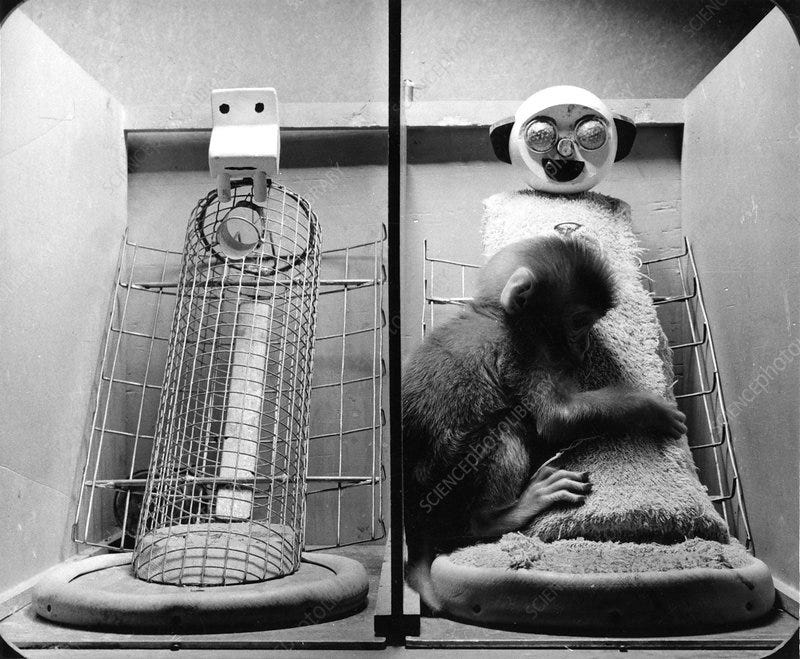
What these studies showed is that attachment to another human being (usually in a position of authority, like a parent) is essential to forming a sense of personal safety. And this applies equally at work as it does at home. I’ve been working with clients on overcoming imposter feelings, which have come up when they’ve encountered new situations like being promoted, or starting to present to more senior audiences (e.g. execs or boards). At first I understood this as a fear of being seen as inadequate, which is in line with the original research by Clance and Imes. But as I dug deeper I realised that sense of inadequacy comes from a perception of being judged by others — that new group that you find yourself in. And it’s partly because you don’t know, like or trust each other yet. You haven’t yet formed a secure attachment to each other. And unfortunately there will be barriers to this attachment forming that have nothing to do with how competent you are at your job: how much you are like them (in / out group mentality), their own preferred attachment style, how attached they are themselves to this group.
So when I hear the advice (which I myself have parroted!) about you need to find a mentor, on one level it’s true, but it’s not really enough by itself. To get even more specific, you need to find someone in the social group you want to become a part of, with whom you can form a secure attachment. Critically, it has to be someone inside this group. Many mentors sit outside not just the team but the entire organisation (and I include myself as a coach in this call-out). This proximity is vital to that sense of belonging, and therefore safety, in a given situation.
Reflecting back on times when I felt like an imposter, on one occasion it was when I joined a startup and was surrounded by these very bright people who all had PhDs from the University of Cambridge. I so wanted to be accepted as part of their group, treated like a peer, an equal. But whilst I had been labelled in my family as the ‘intelligent’ one, I did not at that time of joining the company have even a Bachelors degree. The incongruence between the role I played in my family growing up (and therefore the internalised messages), and the situation I found myself in was sharp and overwhelming. What actually helped overcome this was — unsurprisingly — not ruminating on my perceived inadequacies and using that as a force to work even harder. Instead, it was developing a really strong relationship with my manager, who fed back to me on my strengths and what I was doing well, and believed in me until I could develop that self-belief myself, that I was good at my job and deserved to be there. It was not what he said specifically, so much as the care and attention he gave me when I was feeling vulnerable about my position.
What changed wasn’t my level of competence (I was hired based on my experience, which the company desperately needed, not because of my academic credentials!), it was my sense of attachment to the team, mediated by and strengthened through the relationship with my manager. Now I see this pattern play out in other ways: when a client doesn’t have a strong relationship with their manager, they internalise that as a personal failing, that they lack competence, they’re not good enough. And that creates an emotional disconnect that leaves them feeling vulnerable and unsafe.
We need to form strong relationships with people in positions of authority relative to us in order to feel safe.
And what’s more, that trusted adult can then lend you some of their belief in you, until you develop it for yourself. I have fond memories of my English grandfather, Pop, who used to tell me ‘whatever you want in life, just go for it!’. I used to think this was simply about putting the fear aside and going after my goals, but I now realise he was indicating just how much he believed I was capable of — all the possibility that lay ahead of me, if only I could open my mind to it all and make my choice (I now have that tattooed on my arm as a permanent reminder). He believed in me when I didn’t yet believe in myself, and I trusted his judgement because of the loving relationship we had.
This is why I take issue with some advice around imposter feelings, that it’s merely a ‘confidence’ issue. Aside from the fact that confidence is quite a slippery concept to operationalise (heaven knows, psychology has tried over the decades!), saying it’s down to a lack of confidence places the root cause of the issue within the individual — much like when we call it a syndrome too. I know, this line of thinking is pervasive in our hyper-individualistic society. Yet if there’s one theme to take from my work it’s to look beyond the person, to the interactions we’re having with each other and with our environment, as that is where the source of our discomfort, frustration and fear really lies — and also, where we will find our antidotes.
Some thoughts that this thematic analysis of my work brings up for me, that I’ll continue exploring:
How does this trust in an authoritative figure align with what we know about authoritarianism? e.g. is the rise of authoritarianism in the 2020s an understandable response to a world that feels unpredictable, constantly changing, and scary?
How does the concept of secure attachment work in practice in teams? Particularly astronaut crews?
How can secure attachment within teams be cultivated, particularly when as adults we may not have experienced that ourselves growing up?
Your thoughts are very welcome — do leave a comment below or drop me a message.
Ainsworth, M.D.S, & Bell, S. M. (1970). Attachment, Exploration, and Separation: Illustrated by the Behavior of One-Year-Olds in a Strange Situation. Child Development, 41(1), 49–67. https://doi.org/10.2307/1127388
Harlow, H. F. (1958). The nature of love. American Psychologist, 13(12), 673–685. https://doi.org/10.1037/h0047884