


In my work as a coach and with communities I keep noticing the same dynamic: imposter feelings are holding people back from achieving what they want most in their careers — stepping into bigger roles with more responsibility. Almost nobody calls it out as imposter feelings though; instead it is euphemistically referred to as a lack of confidence or self-doubt, or feeling like they don’t deserve their success and downplaying their achievements. These are symptoms of a much deeper root cause. From my research into imposter phenomenon I’ve come to understand it as a fear of being found out as inadequate. It’s the threat of being exposed as a fraud that causes people to shrink back into safety.
This week I’ve been sharing more of my research with the Product community. On Wednesday I spoke at Product Tank Manchester (thanks to Michael for inviting me!), sharing the findings from a novel study I carried out over the summer into the prevalence of imposter feelings amongst Product people. And two podcasts were published where I spoke in greater detail about the phenomenon and its impact on our wellbeing and performance (links to those at the end of this article).
The original researchers into the imposter phenomenon, Dr Pauline Clance and Dr Susan Imes, first noticed a pattern in the women who were coming to their psychotherapeutic practices for support in the mid to late 70s1. These women were highly accomplished, with by all accounts objective measures of success — they had done well at school, university and now in their jobs. However, these women felt like they didn’t deserve the success, instead attributing it to luck, bad judgement on the part of those selecting them for opportunities, or that it was a mistake. They were scared that at some point going to be ‘found out’ and stripped of their status.
Clance and Imes explored what gave rise to these feelings of imposterism — or intellectual phoniness, as they called it. They found that these feelings often emerged from early family dynamics, especially when the messages we receive about ourselves while forming our identity do not fully align with later experiences. For example, parents might cast one child as the ‘academic’ one and another as the one with ‘common sense’, creating early roles and comparisons within the family. A child praised at school for being top of the class may return home to find their achievements dismissed or never quite enough, prompting them to work harder and harder to maintain the identity expected of them. Later, when they arrive at university or a competitive workplace, they encounter peers who are just as capable. The shift from being exceptional to being part of a high-performing group can trigger doubts about their ability and belonging, creating an identity conflict between who they believed themselves to be and who they fear they might be now (i.e. not good enough).
Of course, imposter feelings can also emerge later in life — through organisational culture, transitions, or traumatic work experiences — but Clance and Imes focused on family dynamics because those early narratives often shape how we interpret later uncertainty. In particular, extreme working cultures often reward the very behaviours that mask inadequacy fears: over-preparing, over-delivering, staying late. The environment unintentionally reinforces the imposter pattern.
I want to pause here for a moment for a word on language — the words we choose to describe things really does matter. I purposefully use the terms ‘phenomenon’ and ‘feelings’ as per the original research, not ‘syndrome’, because the latter pathologises what is a very common experience. Imposter syndrome first entered common parlance in the early 80s, and became popularised through social media from the 2010s. According to Clance and Imes, imposter syndrome is technically incorrect and conceptually misleading, as it’s an experience, not a pathology. When we use the term syndrome we are identifying it as a problem inside of you, and therefore asserting that the responsibility for fixing it rests with you too. However, fifty years of research shows that the problem is not with you, but rather, how certain features within the environment leave you feeling unsafe, and that you will not be accepted for who you are, what you’ve achieved, and what you’re capable of.
In my research, I found a staggering 96% of Product people felt imposter feelings!
Compare this to the general population, where the prevalence is around 60-65%. The question is, why are imposter feelings so much higher in Product people?
My theory rests on how Product operates within a business. Whilst most functions can operate vertically in silos with minimal interface between teams (e.g. Marketing can raise a Jira ticket for Engineering to fix the website), Product is oriented horizontally to be truly cross-functional. The effect of this is that the role of product management is poorly understood in many organisations, with many product managers reporting a lack of role clarity, questioning of competence (“What is it Product does?”), and inconsistent feedback. In practice this plays out as the following behaviours:
Constantly switching contexts
Absorbing conflict between teams
Being the glue rather than the owner
Decisions questioned by multiple stakeholders
Solving problems without full ownership (e.g. influencing without authority)
In environments that are ambiguous, high-stakes, and fast-moving, any uncertainty gets interpreted as personal inadequacy rather than a feature of the job. These misaligned expectations create a constant sense that you’re simultaneously responsible for everything and in control of nothing, which is fertile ground for the fear of being inadequate.
In addition, any dysfunction happening between other teams is quickly picked up by Product people — and can become their responsibility to fix in order to achieve their bigger goals around product success. And if this dysfunction is raised with senior leadership? Well, Product might well find itself labelled as the troublemaker for challenging the status quo, rather than commended for raising deep rooted issues within the organisation that are beyond their remit to fix. When you are expected to fix problems you did not create, and are criticised for raising the deeper issues, it creates a dissonance between what you believe your role is and how the organisation responds to you — a prime trigger for imposter feelings.
From speaking to attendees after my talk this week I learnt that this resonates with many across Product. From starting a new job to taking on more responsibilities within an existing role, these feelings surfaced whenever people were stepping into new, unfamiliar territory. In research terms this has been coined crossing the threshold, and can include:
Starting a job with a new company
Being promoted or changing teams within an existing company
Moving country (particularly where the language is unfamiliar)
Changing or merging cultures, e.g. through marriage or migration
Changing socioeconomic status, e.g. growing up working class but landing a white collar job
Being the first in the family to go into higher education
What these all have in common is that they threaten our sense of identity, who we are. Identities are socially constructed and performative2. Who we interact with and what we repeatedly do become cornerstones of how we define ourselves. (Side note: you may like to read this previous article I wrote on how ‘self’ is a process, not a fixed entity for more background on identity construction). When you step into a new space — be that a role, country, etc — there are new expectations of behaviour and skills that you must learn in order to perform well. In admitting to yourself that there is a gap in your knowledge and capability a space is created for imposterism to grow: the old identity no longer fits and the new identity is not yet secure. At its core, imposterism is a safety response: a fear that if the identity you present is questioned, you may lose acceptance, status, or belonging.
In the next article I will cover what we can do to overcome imposter feelings — helping ourselves but also others to manage the fear of inadequacy and lack of belonging.
Listen to podcasts on imposter phenomenon in Product
If you would like to learn more about imposter feelings in Product, here are two podcasts I appeared on recently:
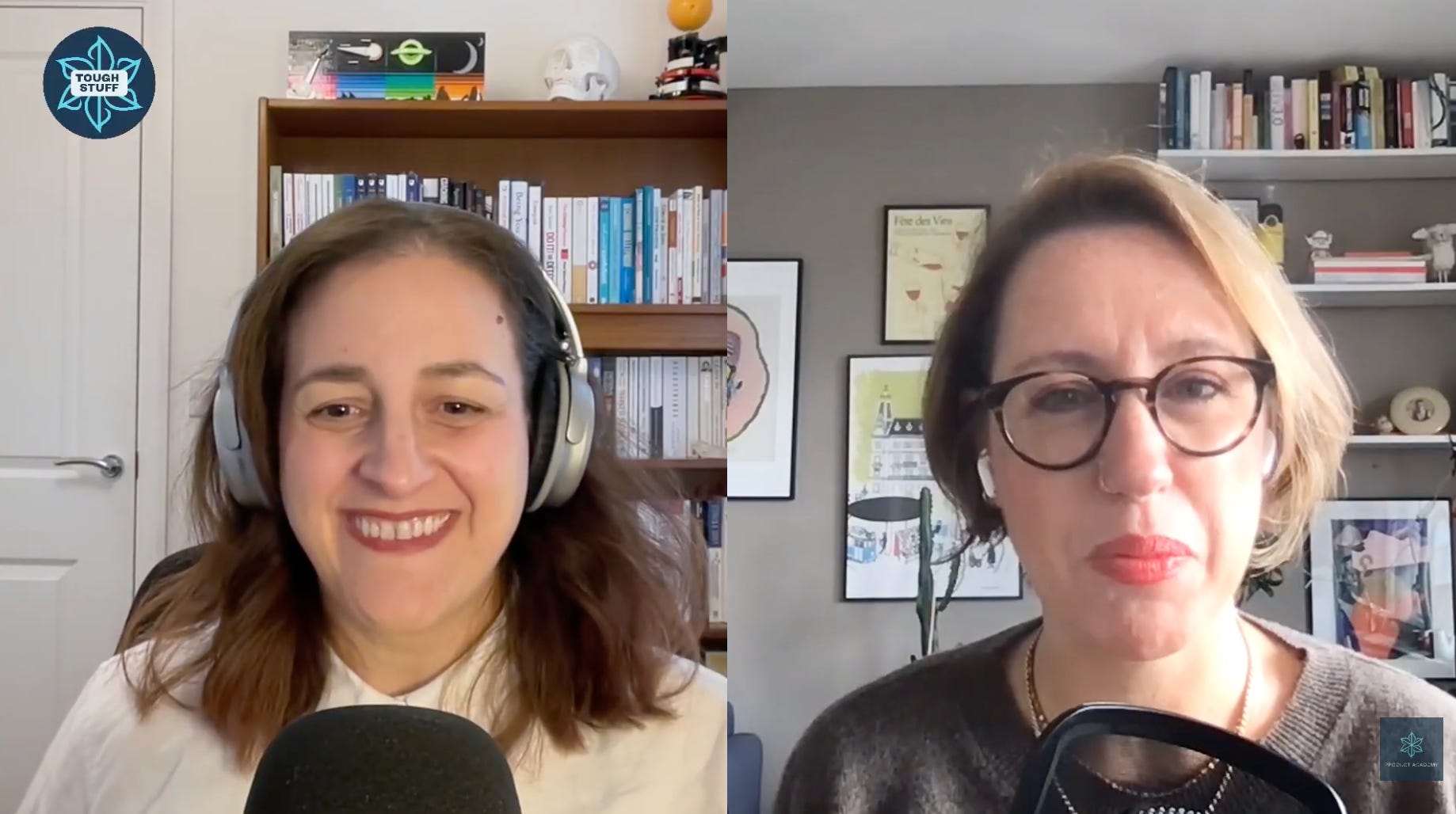
Product Academy Tough Stuff with Francesca Cortesi
Product Confidential with Michael Palmer
Clance, P.R., and Imes, S.A., (1978). ‘The imposter phenomenon in high achieving women: Dynamics and therapeutic intervention’, Psychotherapy Theory, Research and Practice, Vol 15(3), pp. 241-247
Tajfel, H., & Turner, J. C. (1979). ‘An integrative theory of intergroup conflict’, The Social Psychology of Intergroup Relations, W. G. Austin, & S. Worchel (Eds.), Monterey, CA: Brooks/Cole, pp. 33-37