


When you hear ‘extreme jobs’, what comes to mind? Possibly roles in the military, police force, even healthcare (and of course, space). These roles are characterised by working in an extreme environment — in terms of danger or threat to life, the round-the-clock nature and number of hours worked, the level of responsibility incurred. Few might think of office work as falling into this category, and yet there is a train of research investigating how ‘normal’ roles in industries like finance and tech are becoming more extreme over time.
Sylvia Ann Hewlett and Carolyn Buck Luce1 defined these extreme jobs as ones that involve working more than 60 hours per week, with high earnings, combined with additional performance pressures. People working extreme jobs share at least five of the following characteristics:
Unpredictable flow of work*
Tight deadlines and a fast working pace*
After-hours work events*
Availability to clients 24/7*
Inordinate scope of responsibility that amounts to more than one job
Responsibility for profit and loss
Responsibility for mentoring and recruiting
Large amount of travel
Large number of direct reports
Physical presence in the office of more than 10 hours a day
(* The top 4 in this list were shown to be the key characteristics most likely to cause intensity and pressure at work).

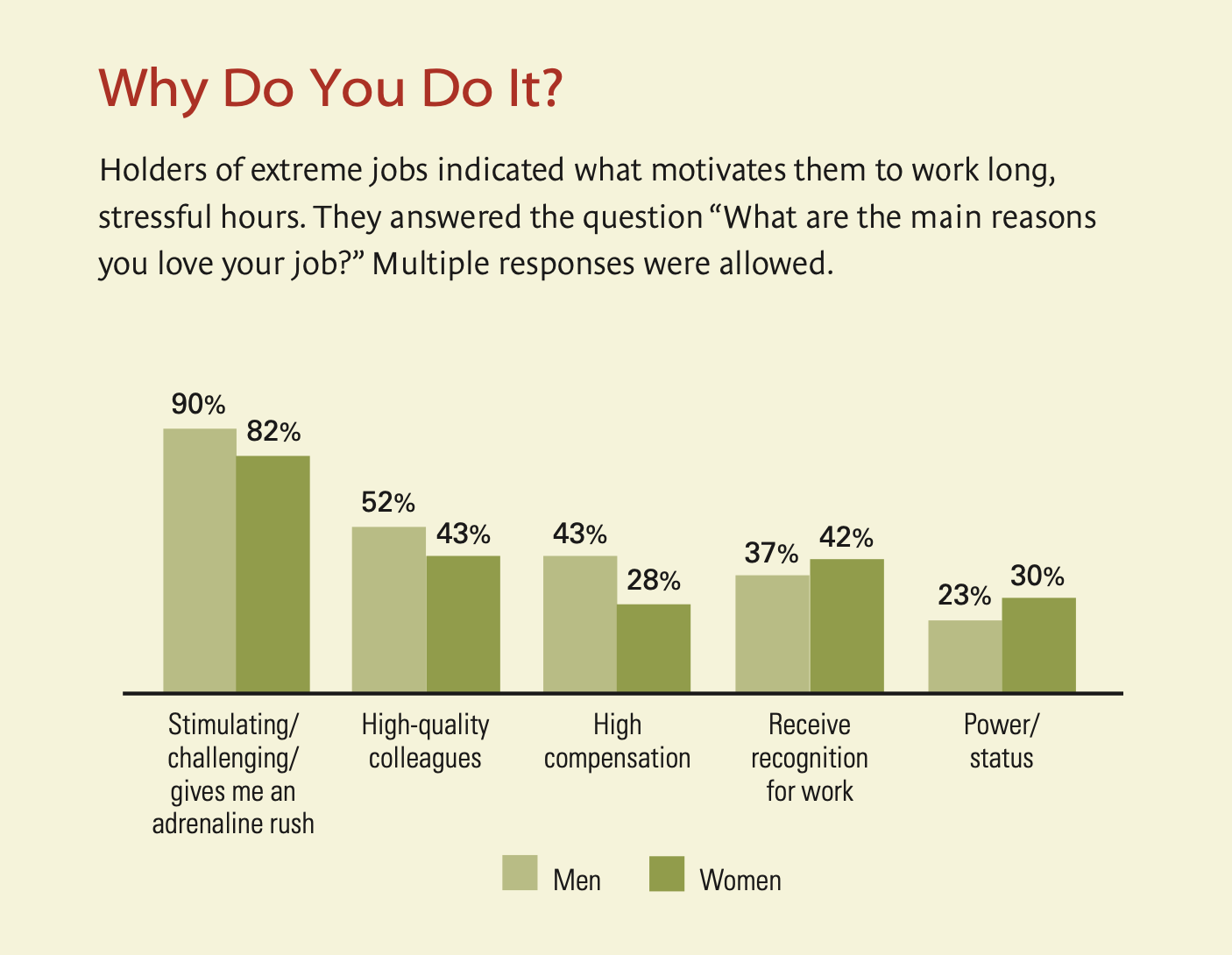
When asked why people do it, many respond that they get an adrenaline rush, have great colleagues, high pay, recognition, status and power. This sounds all too familiar in the tech industry, particularly for those folks who work at Big Tech like Google or Meta, or scrappy startups desperately seeking unicorn status, all of whom have valorised and glamourised ‘the hustle’. Influential figures perpetuate this culture, like Elon Musk setting an expectation of 100+ hour work weeks when he took over Twitter in 2022.
This work-extremism is hard to sustain over a longer period of time, and may be one reason why Silicon Valley executives are turning to ketamine and psychedelics for artificially prolonging cognitive abilities, like creativity and focus. Surely we have to question the value and ethics of a work culture that can only be sustained through regularly taking illegal drugs?
How work extremists rise
Work extremists rise to the top because they’re the ones willing to pay the personal cost that others won’t. They work longer, say yes to unreasonable demands, and become the ‘safe pair of hands’ for senior leaders. This creates an illusion of exceptional commitment or competence, which leads to them being promoted.
Then once in power, they reward and promote others who mirror those same traits, which continues to perpetuate this behaviour. Those who favour more work-life balance may self-select out of promotion opportunities, recognising the demands far outweigh the benefits. This creates a monoculture at the top of organisations, which normalises extremism over time. What is essentially dysfunction becomes rebranded as high performance.
The hidden dangers of rising to the top
One of my clients said to me recently ‘I want to get promoted because it will be easier, I will have more people to delegate the work to so I won’t have to do as much.’ This is a common fallacy, and she will be disappointed to learn that the opposite is actually true. The higher you climb, the more responsibility you have, the more hours you work in order to simply keep up. Hewlett and Luce found that 48% of extreme job holders were working an average of 16.6 more hours than they were five years ago. Speaking from experience as a Product Director, it was common (if not an un-voiced expectation for senior leaders) that I was working six or seven days a week. Monday to Friday was about keeping up with the pace in back to back meetings and making decisions on the fly. The weekend was the only time when I could get ahead with deeper thinking or preparation for what was coming up next.
The extremism of these knowledge-worker jobs concentrates and manifests at the higher levels, precisely when you have fewer peers and more competition for the top spots. And if you don’t keep up then you won’t be considered for further progression. The destruction of your work-life boundaries becomes a rite of passage from middle to senior leadership. Attempting to question this culture leads to you being labelled ‘not the right stuff’, and thereafter experiencing severe curtailment in your career (at least, at that particular company).
Creating a culture of extreme working
There are subtle ways that extreme work patterns are cultivated and even encouraged. In a personal example, I once worked at a startup that moved from a fixed annual leave allowance to Unlimited Paid Time Off. At first you might think this is a glorious perk — now I could take as much holiday as I liked! However, the data we reviewed six months after implementation showed staff actually took less holiday than before the policy changed, even accounting for seasonality. Without clear guidelines on how much holiday was ‘normal’ to take, people were scared to take any in case their colleagues or manager judged they were taking too much. It was not helped by the four founders modelling poor work-life boundaries, working even when they were supposed to be on holiday. It led to the People team having to constantly remind us to take holiday. I now view UPTO policies with a level of scepticism over who is actually benefitting.
Before I stepped into leadership I worked closely with the C-suite at an e-commerce travel company. I remember many occasions where there was a tight deadline and I was expected to get a deck together for a key meeting. It didn’t matter that there had been weeks to prepare as the date was known well in advance, it always seemed to come up at the last minute. Of course, I did it, because I wanted to impress and I was hungry for promotion. But it left me drained, and somehow didn’t quite translate into the career-boosting results I hoped for. Being exceptional in this way fast became a standard expectation from leadership that led to overwork and burnout.
Looking back at these leaders now, I can see how they were adrenaline junkies who thrived on the thrill this way of working created, as they did in other aspects of their lives. Many of them were into extreme sports: ultramarathons, Channel-swimming, wind-surfing, long distance cycle racing. It was a particular kind of privilege (or perhaps ignorance) that they were oblivious to not everybody being like them and motivated by that same kind of rush. They viewed those who did not share their obsession to be less worthy of their time, attention, and ultimately, employment.
However, it does lead me to question whether the extremists always end up at the top, because they’re the only ones mad enough to work the hours necessary to make a business a success? It’s worth noting that these extremists often do not have other commitments on their time, so they can afford to obsess over their work above all else. If they do have dependents, they are taken care of by somebody else. Job extremism favours male, single, young, child-free.
When extremism becomes identity
Many folks who work in extreme jobs see themselves as special compared to everybody else. Only they can put the hours in that are required to keep the company going. This attitude feeds a hero complex, which if left unchecked becomes their identity. ‘I am a hard worker, I work harder than anybody else’.
At this stage what you do becomes who you are — a type of cognitive fusion. It distinguishes the in- from the out-group: those who are prepared to do everything necessary to achieve the end-goal, and those who aren’t (because they have families, lives outside of work, etc). In a bygone era these extremists would have been mocked for not having their priorities in the right place, but now they are revered as champions of capitalism.
Rejecting extreme jobs
Interestingly, I see a backlash mounting against hustle culture and other manifestations of extreme jobs. The pendulum has perhaps swung too far in favour of work over life, which hasn’t led to the eternal happiness and true meaning and purpose as promised by the capitalists.
A truly extreme job often has meaning:
A doctor in A&E saving lives
A police officer attending a crime scene or court to bring justice for victims
An astronaut carrying out experiments to further our knowledge of the universe
The extreme aspects of the job are traded-off with the benefits, which are obvious and of common good. Meanwhile, extreme knowledge-work jobs often have a less tangible, less real-world sense of meaning, which often boils down to one thing: increasing profits for shareholders. Is this really what motivates the vast majority of people? (of course, it will for some, but I argue those are a minority).
I question why people are exposing their lives to so much stress and danger, for something so abstract and largely of benefit to just a few within society? In psychological terms, this is a collective form of maladaptive perfectionism. Extremism in knowledge-worker jobs is a pathology, not a virtue: a symptom of a system that confuses overwork with excellence.
Hewlett, S. A. and Luce, C. B., (2006) ‘Extreme Jobs: The Dangerous Allure of the 70-Hour Workweek’, Big Picture, December 2006, pp. 49-59
Love this Caroline, it resonates so much and made me think of all the times me prioritising family meant missing out on opportunities or being frowned upon. It's so frustrating seeing this culture of over work being the norm...