

If the body and the crew are the visible parts of confinement, the mind is the hidden challenge. We’ve already covered the physical and social aspects of living in isolated, confined and extreme (ICE) environments, based on my experience of an analogue space mission. Now we’re going to look at the psychological experience.
Mindset and the inner critic
As a leadership and performance coach, I’ve done a LOT of work on my mindset.
Coach training in particular created a space where I had to confront those less helpful aspects of my psyche: first to be aware that they exist and how they manifest, and next to work on reframing them into something more compassionate.
Prior to that I had spent ten days in silent retreat in the Indian Himalayas near MacLeod Ganj, the home of His Holiness the XIV Dalai Lama. There I spent twelve hours a day learning about Buddhism and practising meditation.
And then of course there is my psychology degree. Four and a half years, with a specialism in social-cognitive psychology, taught me the connections between our inner worlds and our behaviours, particularly when it comes to group situations.
All this to say, it doesn’t mean there aren’t times when I hear my inner critic pipe up with his rote phrases — he does, and with some intensity when it’s new experiences — but that I now have a toolkit to handle him (yes, my inner critic is a man!)
He was particularly vociferous the days leading up to the analogue mission. I don’t think it helped I was feeling unwell; being physically not my best means my psychological defences are down too, giving him opportunity to make an appearance. Here’s some of the things he was saying to me:
‘You’re not going to survive being locked in, unable to leave for 5 days’.
‘You’re going to have problems sleeping as it’s a shared dorm'.
‘You’re going to disrupt everybody else with your frequent need for the toilet’.
‘You’re not good enough to be doing this, who do you think you are?’
Much of the chatter related to physical discomfort, which highlighted to me just how important my environment is to feeling and performing at my best. To counter these attacks, I just kept reminding him that I had done something very similar before. This is a technique I use with clients too — asking them when they may have been in a similar situation, and how did they find that? In this case it was my ten day silent retreat: we couldn’t leave the retreat AND we couldn’t speak during it. I have evidence of testing myself in this capacity and being totally fine and not dying.
You see, the purpose of the inner critic is to keep us safe. And in some situations that is vital for survival: it’s the inner critic that tells you not to get in the car with someone you don’t trust, or walk down that dark alley at night. The problem is when the inner critic turns itself on you, attacking you and who you are. ‘You’re not good enough’ not only stops you from acting in the way you are thinking about, it creates shame.
Shame is all about feeling unworthy of love because you are flawed in some way. As an autistic woman who was late diagnosed I spent a large part of my life experiencing this. Brene Brown has extensively researched shame, and found that shame drives disconnection; the antidote is therefore to seek out connection with others. And we can do this through talking about how we’re feeling. I shared my thoughts with my partner and a couple of trusted friends. Of course, their reassurance was nourishing and helped calm that inner critic down.
A single question was on repeat like a jammed record: ‘why me?’ — why should I be the one to go on an analogue space mission? I don’t consider myself particularly special. But that’s the thing — neither do the other people going on missions, and even space astronauts themselves! Instead, these are ordinary people doing extraordinary things. So instead every time the inner critic asked ‘why me?’, I answered ‘why not me?’. Why shouldn’t I be the one to have this amazing experience? It’s the natural next step in my journey towards space psychology.
And it’s this same energy when people hear what I was doing (or since, have done!) and say to me ‘I could never do that’. Why not? What is it about this experience that you find scary? What is your inner critic telling you about yourself or your abilities to cope?
Confinement didn’t just test my body — it tested my beliefs about myself. That’s what the inner critic was really afraid of.
Stress and coping strategies
Living in close proximity to six other human beings, with no way to change your external environment, is a recipe for stress. There was a consistent background level present simply because of the unusual circumstances: being away from familiar surroundings, being restricted in what you could do, having very little opportunity for ‘alone time’. This meant engaging an ‘always on’ mode, right from when you wake up to when you go to bed. The stress level was ambient, and cumulative, rather than a crescendo of crisis.
It’s no wonder in these circumstances there were times I felt my stress levels rising and needing to have a time out. I wasn’t the only one — at some point through the mission every member of the crew found a way to carve out some space just for themselves.
For me that came on the afternoon of the first day. I was feeling overwhelmed with the novelty of the experience, the buzz from meeting new people and learning the environment, and recovering from illness. My strategy was simple: go and sit in the BioLab with the plants for a while. During Covid, I — like many others — went a bit houseplant mad. Every time I went to the shop on our government-permitted excursions, I would grab another. Soon my house was filled with cacti and orchids and spider plants and money trees — some are still alive to this day!
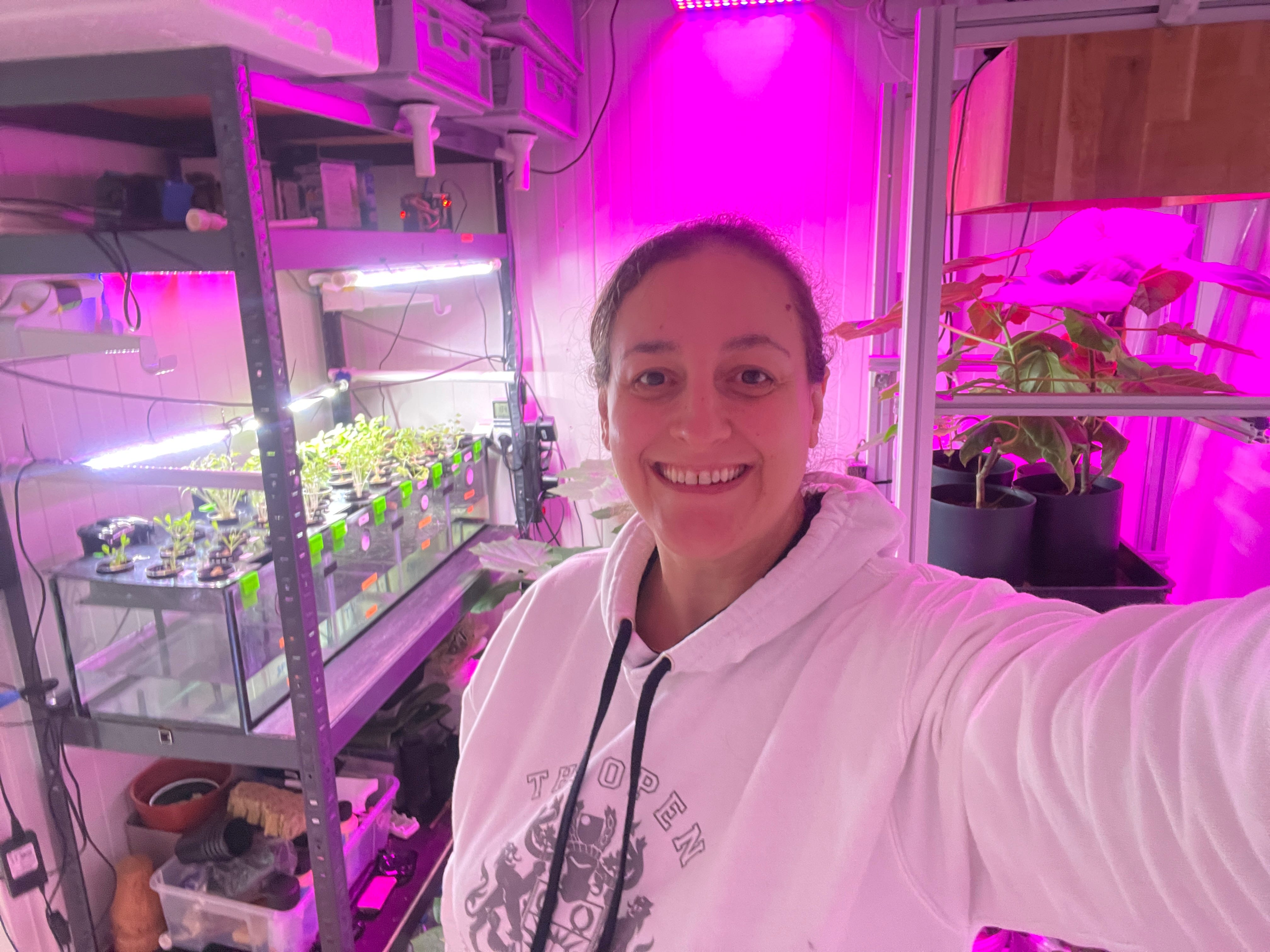
The BioLab housed a range of hydro- and aeroponic plants such as lettuces, basil, even tomatoes, and I found it calming to sit there listening to the background hum and drip-drip-drip. A few mother-in-laws-tongues sat in pots on shelves under UV lights, and I stroked their sword-like leaves to self-soothe. Even in confinement, the pull towards nature was strong. Sitting among the plants tapped into something deeply calming: psychologists call it biophilia, the idea that humans have an innate need to connect with living systems. For me, being with the greenery worked as a reset button.
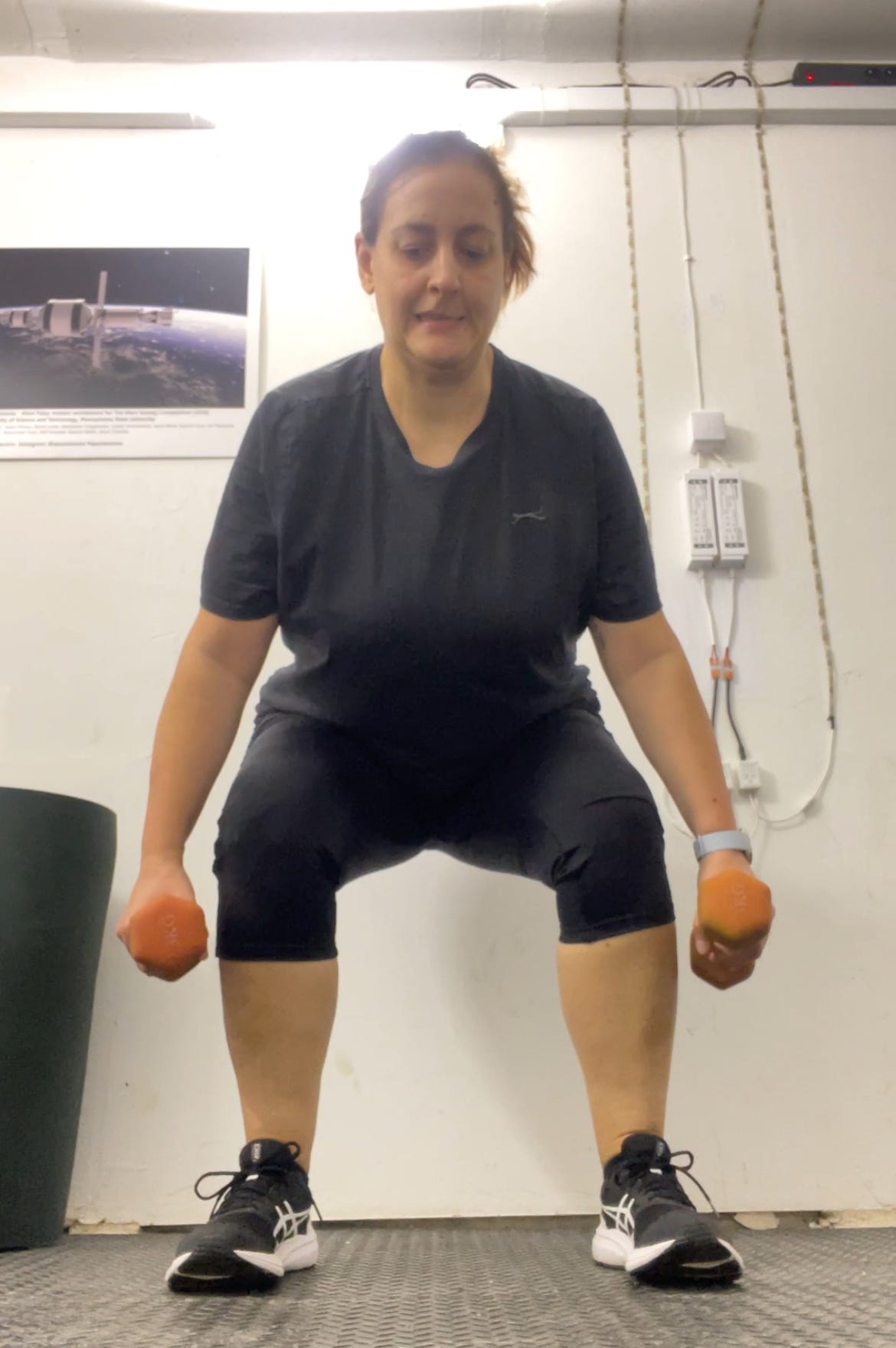
Another way I coped with stress was to replicate my home routine as closely as possible. That meant getting up early to exercise in the airlock. The equipment was somewhat limited — an exercise bike and treadmill for cardio, and a few light weights (3kg!) — but I adapted my usual routine to focus more on bodyweight and calisthenics. Since my school days, and particularly in my 20s and 30s when I played a LOT of rugby, I’ve found exercise essential for managing stress. There’s nothing better for working out some issues, than slamming your body hard into another when tackling or rucking… (and all perfectly legal!) Rugby may no longer be part of my daily life, but the principle is the same: moving my body has been the most reliable way I know to regulate stress.
Downtime and boredom
Most people imagine confinement as boring: endless hours with nothing to do. For me, it was almost the opposite. Between the lectures, EVAs, daily routines, and simply living in such close quarters, there was very little true downtime. If anything, the challenge was the lack of space to switch off. The ‘always on’ mode of being around others meant the days were full, sometimes even overstimulating.
That surprised me, because in the literature monotony is usually described as a big risk. Space psychologists are particularly concerned with the impact of monotony on crew performance as it’s a critical stressor causing slower response times in tasks — whether that’s the lack of variety in the diet, the repetitive work schedule, or the dearth of stimulating scenery. Perhaps this was because my analogue mission was relatively short in duration? CHAPEA, which NASA is sending four astronauts on this October, is a year-long isolation in a habitat just 157 sqm, to simulate living on Mars. Compared to my meagre five days in ICE, I can imagine how monotony and boredom are critical cognitive risk factors.
As a result of the full-onness of each day I found I needed a little time to unwind before bed. I’m a huge fan of audiobooks and I’d brought with me Mary Ann Sieghart’s The Authority Gap, which the author herself narrated. I absolutely loved it (and highly recommend reading it yourself if you haven’t yet), but I have to say, the statistics bits really helped with calming me down enough to feel sleepy (please take that as a compliment, Mary Ann!)
Insights and reflections
Going into this mission I knew that the psychological game was going to be the key to success. What surprised me the most then, is learning first-hand the salience of the mind-body-environment connection, and how I could only improve my mental performance through taking care of my physical being whilst adapting to a novel environment with unfamiliar constraints. Perhaps I had always known it deep down, or even taken that for granted?
Just this week I connected with Corey Twine, a human performance specialist who works with astronauts at NASA, and he shared a diagram that neatly shows all the different areas of study within this domain:
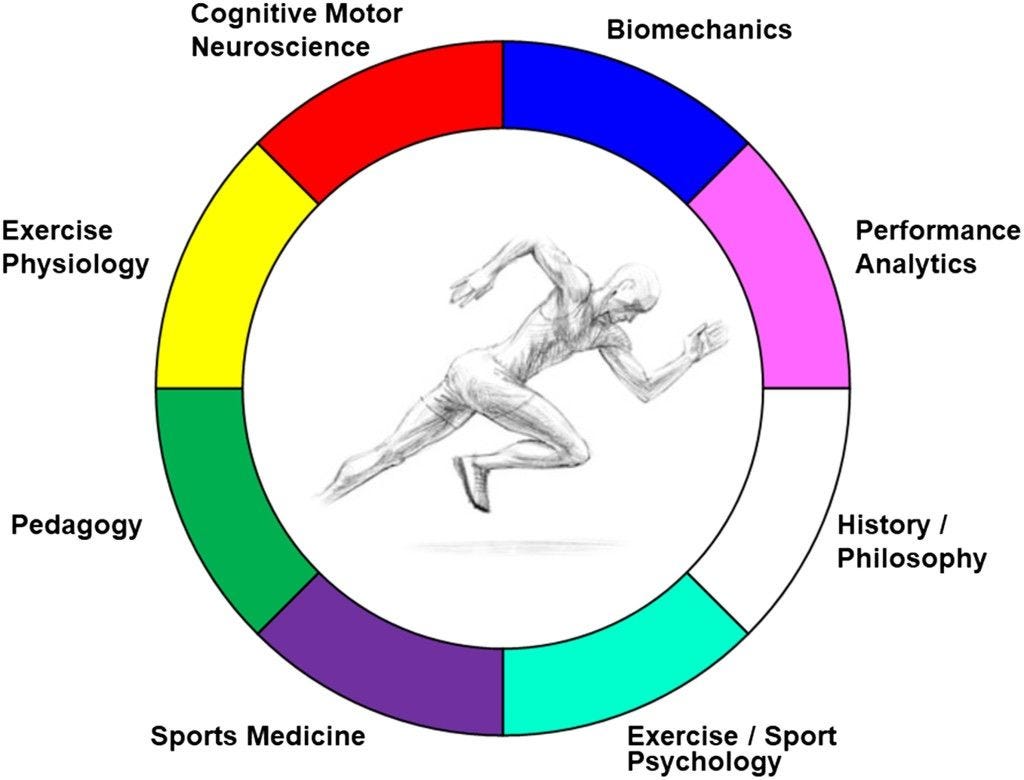
(It’s super ironic, because when I was choosing the elective modules on my degree I was seriously torn between social psychology and sports psychology — and now I wonder if I made the right choice?)
The thing that both human factors and human performance disciplines have in common is viewing the human body as a system, within a system (its environment). In Corey’s own words: “Human Performance is not just strength and conditioning, or rehab, or nutrition, or psychology — it’s the integration of them all.”
As an aside, over the summer I applied to Manchester Metropolitan’s masters course in psychology of human performance — and got accepted! However, I’ve made the super-hard decision not to go ahead with it, because it’s a full time course on campus, and I just don’t know how to make a 3 hour each way trip work each week. I’m feeling deeply conflicted about the decision, but sometimes the right course in the wrong place is still not the right one. For now, I’m trusting that another door will open in a way that fits better.
Living through this mission showed me just how tightly the psychological, physical, and social strands are inseparably woven together. In the next article, I’ll take you outside the hatch and into the EVAs — where precision, teamwork, and mindset were tested in real time.